Talos Configuration and Machine Management Platform¶
Working design concept, staged delivery and option analysis
| Document status | Working architecture concept - not yet an implementation specification |
|---|---|
| Revision | 0.5 |
| Date | 6 September 2026 |
| Technical baseline | Talos Linux 1.13 (v1.13.6); Omni 1.9 (v1.9.3); OpenBao 2.6 (v2.6.1) documentation |
| Scope | Talos configuration, secrets and machine lifecycle as an open alternative control plane, without CAPI or infrastructure provisioning |
Purpose: This document consolidates the full design discussion so far: the problem being solved, the architecture and lifecycle workflows, the backend and security model, the comparison with Omni, and the design alternatives that remain open.
| Revision | Changes |
|---|---|
| 0.1 | Initial concept notes. |
| 0.2 | Consolidated design, lifecycle workflows, backend and security model, Omni comparison. |
| 0.3 | External technical review: version baseline updated (Omni 1.7 -> 1.9.3, OpenBao 2.6.1, Talos v1.13.6); corrected SideroLink endpoint/port wording, Talos apply-mode list and reset-wipe defaults; citation and reference-URL fixes; added installer-image sourcing, etcd backups, multi-version renderer, implementation language and project licence considerations; Omni comparison refreshed for 1.8/1.9. |
| 0.4 | Decisions recorded from the 0.3 review Q&A: build gate evaluated (three hard differentiators confirmed); Go decided as implementation language; version 1 scale target ~100 machines; scheduled etcd snapshots moved into version 1 scope (SnapshotEtcd); installer images via public Image Factory with a per-site platform proxy reserved for later; normative site egress requirement added (10.10); figure corrections identified (Figures 2-4). |
| 0.5 | Existing-cluster configuration control first; secret extraction before persistence; structural references; provider and database investigations; dependency retention; application approval boundary; evidence-based operation recovery; explicit restoration recovery mode; native Talos compatibility. |
Revision 0.5 reconciles the September discussion and peer review. The 0.4 to 0.5 transition review records the changes and remaining investigations. This is a design, not evidence of implemented guarantees or passing experiments. The technical baseline and Omni comparison remain the 3 August snapshot; this revision does not claim a fresh product or licensing comparison.
Contents¶
- Executive summary
- 1. Problem statement and design intent
- 2. How the concept evolved
- 3. Current decisions, preferences and open points
- 4. Terminology and state model
- 5. System architecture
- 6. Talos-native configuration model
- 7. Database and secret-provider design
- 8. Machine identity, discovery and enrolment
- 9. Machine and cluster lifecycle workflows
- 10. Connectivity and transport options
- 11. Northbound web API
- 12. Reconciliation, rollout and drift
- 13. Security model
- 14. Reliability, high availability and disaster recovery
- 15. Observability and operational support
- 16. Design options still under consideration
- 17. Recommended baseline and initial scope
- 18. Phased implementation and proof of concept
- 19. Risks, unknowns and next design questions
- 20. Comparison with Omni
- Appendix A. Example data and API shapes
- Appendix B. Operation catalogue
- Appendix C. References
Executive summary¶
We are designing an open, self-hosted Talos control plane for organisations that already own the infrastructure beneath their clusters. It manages already-booted Talos machines and existing Talos clusters: compose and protect complete machine configurations, apply and verify changes, enrol maintenance-mode machines, create clusters from assigned machines, and reset or reuse machines safely.
At this scope, Omni is the reference implementation and primary comparison. Omni already provides machine enrolment, Talos configuration generation, scoped native patches, automatic reconciliation, cluster creation, upgrades, machine reuse and existing-cluster import. The proposal is therefore not configuration management that Omni lacks; it is a deliberately different control and ownership model. [M1] [M2] [M5]
The intended differentiators are operator custody of native Talos configuration and cluster secrets, first-class reusable fragments and profiles across clusters, explicit draft/publish/approve releases, source provenance and managed drift, optional rather than constitutive transport, retained direct Talos access, infrastructure provisioning outside the product, and an open-source licensing target.
The emerging architecture uses native Talos multi-document YAML and Talos APIs as the canonical configuration model, an authoritative relational database, and versioned secret and encryption providers. PostgreSQL is the server option and, with OpenBao as the primary provider, forms the one PoC profile (§7.7); SQLite and a local age-backed store were investigated and are not part of it, and SOPS/age is kept for import/export only. Git is not the backend. Talhelper is not required. CAPI is explicitly avoided.
The connectivity layer is deliberately transport-independent. For routed internal environments, direct access to each machine on the Talos API is the simplest baseline. SideroLink remains an optional call-home transport for NAT, edge or less trusted networks; its grpc_tunnel mode avoids UDP by carrying WireGuard traffic over the long-lived SideroLink gRPC connection on TCP; the SideroLink endpoint URL and port are deployment-defined, commonly exposed on 443. A site relay is another option for reaching an entire remote network through one outbound web-compatible connector. [T1]
Current recommended baseline: First prove the configuration-specific differentiators on direct internal networks: existing-cluster adoption, native fragment/profile reuse, secret custody, immutable releases, approvals, provenance, drift handling and recovery. Reset/reuse and cluster creation belong to later lifecycle delivery. Add SideroLink-over-gRPC and site-relay transports later. If these differentiators are not hard requirements, Omni is the rational choice and rebuilding it would be unjustified. Revision 0.4 records that three differentiators are confirmed hard requirements (open-source production licence, explicit releases and approvals, direct Talos access with optional SideroLink), so the build path is currently justified.
1. Problem statement and design intent¶
1.1 The gap¶
Omni is the closest existing product and already covers most of the machine and cluster lifecycle described here. The gap is not a missing ability to generate and reconcile Talos configurations. It is the combination of ownership and workflow requirements: external secret custody, native configuration as an operator-owned asset, first-class cross-cluster reuse, immutable releases and approvals, direct or site-native connectivity, a conventional web API, and an open licence. [M1] [M2] [M4]
The desired product is therefore best understood as a configuration-centric, transport-agnostic alternative Talos control plane - not merely a hosted Talhelper and not a generic infrastructure platform. It should borrow proven Omni semantics where they are sound and diverge only where a stated requirement demands it.
1.2 Primary goals¶
| Goal | Meaning |
|---|---|
| Manage complete Talos configuration | Compose, validate, version, approve, apply and verify full native machine configuration, including secret-bearing fields. |
| Manage secrets correctly | Extract known/marked secrets to the selected provider before plaintext persistence; pin every release dependency and retain required versions. |
| Support reusable YAML | Use focused native Talos YAML fragments, named profiles, explicit merge order and local YAML anchors where useful. |
| Manage both unconfigured and configured machines | Handle maintenance-mode candidates, available machines, active cluster nodes, failed provisioning, reset-to-pool and retirement. |
| Operate existing clusters | Adopt running clusters without resetting them, establish a baseline, add management connectivity and preserve break-glass access. |
| Create clusters without CAPI | Assign available machines, generate role-specific configuration, apply it, bootstrap etcd once and verify Kubernetes. |
| Expose a real web API | Provide a stable REST/JSON API for users, automation and a future UI, independent of the southbound Talos transport. |
| Survive management-plane failure | Managed clusters must continue running normally if the database, secret/encryption provider or manager is temporarily unavailable. |
1.3 Explicit non-goals¶
| Non-goal | Boundary |
|---|---|
| No CAPI dependency | Do not model desired VM counts, infrastructure providers, MachineDeployments or provider-specific replacement workflows. |
| No VM or hardware creation | Do not create VMs, operate hypervisors, allocate cloud instances, control Redfish/BMC, or run PXE in the initial product. |
| No Git backend | Git export may exist, but Git is not the authoritative desired-state or revision store. |
| No Talhelper runtime dependency | Talhelper may later be an import adapter, but the core consumes native Talos semantics directly. |
| No Kubernetes workload GitOps | The platform may observe Kubernetes for health and drain operations, but it is not Flux, Argo CD or an application platform. |
| No mandatory KubeSpan | Cluster data-plane networking remains outside this design unless a specific cluster independently chooses KubeSpan. |
| No database or vault service operation | Operators provision and operate database/vault services, HA, backups and restoration; Bronzeward owns its schema, migrations and application recovery. |
| No proprietary Talos replacement schema | Do not recreate every Talos option behind another platform API. |
1.4 Guiding principles¶
-
Talos owns machine semantics. The platform owns composition, secrets, approval, transport, rollout and audit.
-
Thin management metadata. Machine assignments and profile ordering may be platform-specific; actual machine settings remain native Talos YAML.
-
Transport is a replaceable implementation detail. Direct TCP, SideroLink and site relay must feed the same operation engine.
-
Destructive actions are workflows. Reset, wipe, bootstrap and upgrades require durable intent, coordination, operation-specific retry decisions and explicit verification; a lock is not remote fencing.
-
Configuration publication is immutable. Drafts are mutable; releases, source references, renderer versions and secret generations are not.
-
Break-glass independence. The manager should improve control without becoming the only remaining route to recovery.
-
Boring data integrity beats cleverness. The selected database handles relational state and transactional publication; the selected secret/encryption providers protect secret values and artifacts.
-
Omni is the reference baseline, not a straw man. Reuse proven scope, safety, import and lifecycle ideas; do not rebuild features merely to be different.
2. How the concept evolved¶
The discussion initially surveyed known Talos tools. Those tools were useful for defining the negative space, but they did not match the desired concept. The design then converged through the following steps:
| Evolution step | Result |
|---|---|
| Tool survey rejected as the answer | Talhelper, Talm, operators and CAPI-based systems either remained local push tools or focused on provisioning and cluster infrastructure rather than post-install configuration control. |
| Product category identified | A persistent Talos configuration and machine control plane: configuration compiler, secret broker, inventory, connection layer and reconciler. |
| Talhelper made optional, then unnecessary | The clean core can use upstream Talos generation, multi-document configuration, patching, validation and Machine API operations directly. |
| Git removed from the architecture | PostgreSQL now provides drafts, immutable revisions, relationships, approvals, operations and observations. Export remains desirable, but Git is not authoritative. |
| OpenBao introduced | OpenBao stores Talos secret generations and management credentials; Transit can encrypt full compiled configurations stored in PostgreSQL. |
| CAPI explicitly excluded | Cluster creation means assigning existing Talos machines, applying configurations and bootstrapping once - not owning infrastructure resources. |
| Machine lifecycle widened | The system must distinguish pending maintenance machines, available machines, active nodes, resets, orphans and full retirement. |
| Connectivity separated from control logic | Direct internal access, SideroLink, a site relay and a hypothetical custom extension are alternative transports behind one interface. |
| Web API clarified | The northbound user API should be REST regardless of southbound transport. A restrictive remote-site use case may additionally require an outbound web-compatible connector. |
| Omni reframed as the reference implementation | The concept overlaps substantially with Omni. The comparison shifted from a supposedly missing category to an alternative ownership, release and transport model. |
| Configuration novelty narrowed | Generated base plus native patches plus effective config plus reconciliation is not new. Candidate value lies in profiles, explicit releases, external secret custody, provenance, direct access and a clean exit path. |
The September review then narrowed first delivery to existing-cluster configuration control, made OpenBao the primary rather than mandatory provider, and introduced the SQLite/local-encryption investigations. Sections 6–7 and 12–14 state the reconciled contracts; the earlier PostgreSQL/OpenBao steps above describe how the concept began.
3. Current decisions, preferences and open points¶
| Topic | Current position | Status |
|---|---|---|
| Canonical machine configuration | Native Talos multi-document YAML and upstream Talos semantics | Decided |
| Reusable configuration | Named fragments and ordered profiles; YAML anchors only within a stored document | Preferred |
| Talhelper | Not required; possible import adapter later | Decided |
| Git | Not the backend; export/import only | Decided |
| Relational backend | PostgreSQL for the PoC (§7.7); SQLite single-instance deferred until dispatch is evidenced on it; MySQL/MariaDB only if required semantics come at negligible extra cost | Decided for the PoC |
| Secret backend | OpenBao KV v2 and Transit for the PoC (§7.7); local age-backed store not selected; SOPS/age import/export only; provider-neutral references | Decided for the PoC |
| Talos service credentials | Per-cluster, operator-written, provider-held talosconfig (§13.2); native certificate issuance deferred | Decided |
| Secret authoring | Automatic Talos bundle extraction; operator marking for other secrets; whole-value structural references | Decided; specified for the PoC, pending owner review (compilation contract §16): an explicit !bwref tag resolved before composition (§5–§6) |
| Approval | Trusted controller enforces immutable approved plans; PoC: one approval per plan, adoption baselines included; self-approval allowed and recorded; revocation by any approver or recovery-admin, effective against every attempt not yet recorded (§13.7) |
Boundary decided; decided for the PoC |
| Identity and roles | PoC: OIDC for humans, with roles from identity-provider group claims; hashed Bronzeward-issued bearer tokens for automation, issued with a server-side tool; viewer, author, publisher, approver and recovery-admin, granted installation-wide; automation never approver or recovery-admin (§13.7) |
Decided for the PoC |
| Direct operator Talos access | Operators keep their own talosconfigs; an SSO certificate companion is deferred and is never application authentication (§13.8) | Decided |
| Recovery | Evidence-based interrupted-operation handling; explicit recovery mode after restoration | Decided |
| Retention and alerts | PoC removes no provider object (and, derived, no release, artifact or source record); recovery window is the operator's backup retention; persistent-unknown alert after 15 minutes; manual unseal (§7.8) | Decided for the PoC |
| First milestone | Configuration control on an existing cluster | Decided |
| CAPI | Avoided and outside scope | Decided |
| Infrastructure provisioning | Outside initial scope | Decided |
| Northbound interface | REST/JSON web API with asynchronous operations and event streaming | Preferred |
| Default southbound transport | Direct Talos API on internal management networks | Recommended |
| Remote/NAT transport | SideroLink, preferably grpc_tunnel where UDP is unavailable | Open option |
| Strict web-only remote transport | Site relay or REST-polling connector | Open option |
| Custom Talos extension | Deferred last resort | Deferred |
| Kubernetes API path | Normal cluster endpoint for direct sites; proxy/relay only where required | Preferred |
| Drift correction | Report by default; operator chooses revert or adopt | Preferred |
| Automatic rollout | Conservative, policy-controlled; destructive and control-plane actions require approval | Preferred |
| Omni relationship | Primary reference implementation and competitor; avoiding CAPI is not by itself a distinction from Omni | Decided |
| Build/no-build gate | Evaluated 3 Aug 2026: open-source production licence, explicit releases/approvals and direct Talos access with optional SideroLink are hard requirements; OpenBao custody is a preference. Currently favours build; re-check each Omni release | Architectural gate |
| Configuration source classes | Separate machine configuration, identity/secrets, image/extensions, kernel/early-boot arguments and platform injection | Preferred |
| Implementation language | Go; aligns with upstream Talos client machinery and talosctl. Single static management binary preferred, not final | Decided (Go) |
| Scale target (version 1) | Roughly 100 machines across several sites and 5-15 clusters; design and test at this order of magnitude | Decided |
| etcd backups | Scheduled snapshots to S3-compatible object storage with retention; RecoverEtcd starts from platform-owned snapshots | Decided |
| Installer image sourcing | Public Image Factory in version 1; per-site platform image proxy/cache reserved for a later phase | Decided |
| Project licence | OSI-approved licence required; exact licence (Apache-2.0, AGPLv3, MPL-2.0) not yet chosen; must be selected before first public release | Open point |
Important: “Open option” does not mean the architecture is undefined. It means the core is deliberately designed so that the option can be selected per environment without changing configuration, secrets or lifecycle semantics.
4. Terminology and state model¶
4.1 Machine versus node¶
A machine is a Talos-capable compute instance known to the manager. A cluster node is a machine currently configured and assigned to a Kubernetes cluster. This distinction matters because maintenance-mode systems have no cluster identity, while a reset machine may retain its stable manager identity even after its Kubernetes Node object and Talos cluster credentials are gone.
4.2 Primary lifecycle categories¶
| Category | Definition |
|---|---|
| Candidate machine | Talos is in maintenance mode; the manager has observed it but has not approved or claimed it. |
| Available machine | Approved, unassigned and ready to receive a cluster role/configuration. |
| Provisioning machine | A full configuration is being compiled, applied, installed or verified. |
| Cluster node | Configured, assigned to a cluster and actively reconciled. |
| Orphaned machine | The manager cannot prove the machine completed its assigned operation or still matches its recorded identity/state. |
| Retired machine | Decommissioned or fully wiped; automatic return requires external provisioning. |
4.3 Orthogonal state dimensions¶
A single giant enum would produce an unmanageable number of combinations. The database should model several dimensions separately and derive user-facing states from them.
| Dimension | Example values |
|---|---|
| Enrolment | pending, approved, rejected, revoked |
| Talos mode | maintenance, configured, unknown |
| Assignment | unassigned, cluster/controlplane, cluster/worker, retired |
| Connectivity | connected, reachable, disconnected, unknown |
| Operation | idle, applying, installing, resetting, upgrading, wiping, bootstrapping |
| Health | healthy, degraded, failed, unknown |
| Configuration | desired, applied, observed, plus digest equality/drift |
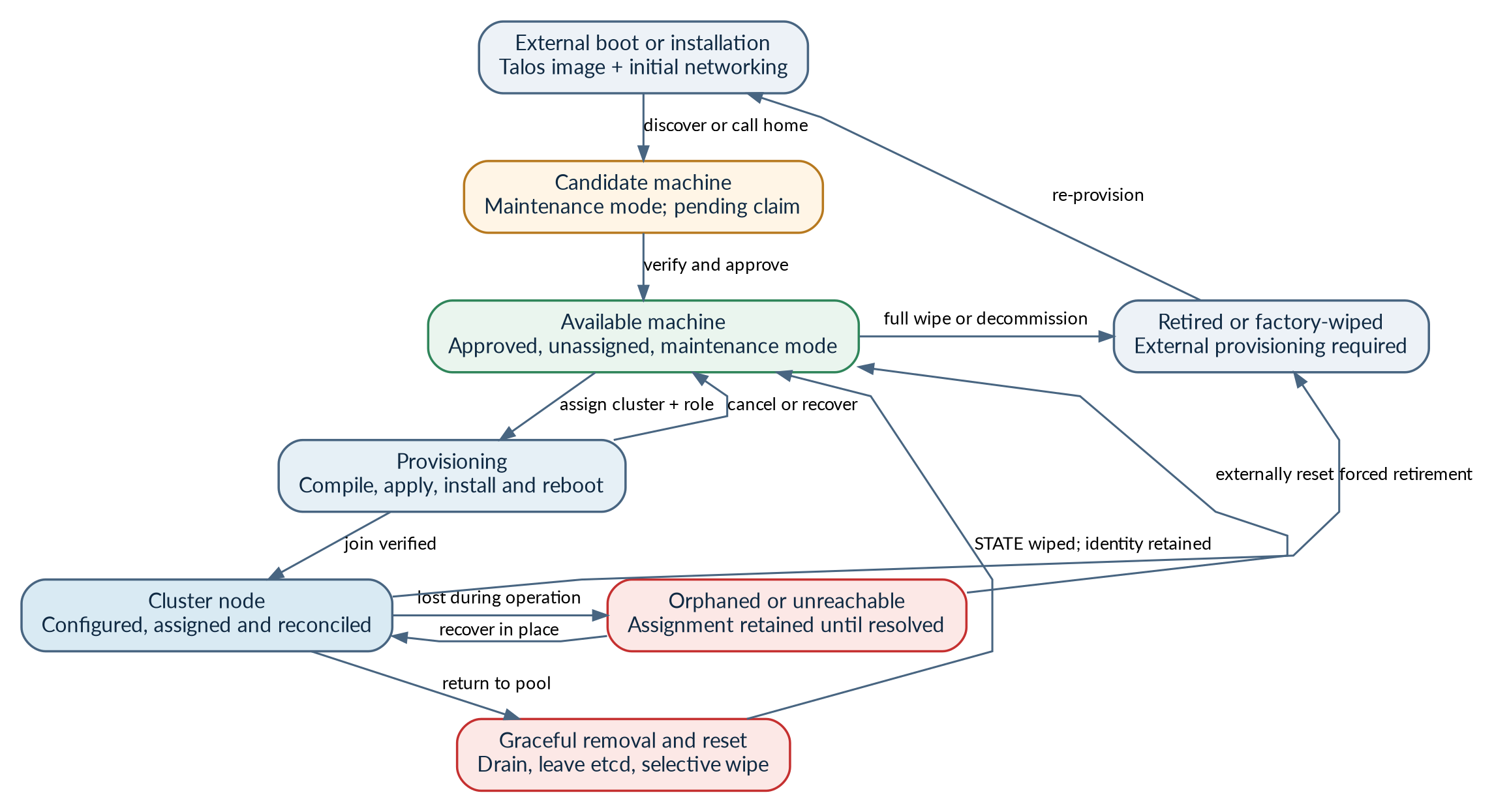
Figure 1 - Proposed machine lifecycle. A full factory wipe deliberately leaves the managed lifecycle and requires an external boot/install mechanism.
4.4 Identity layers¶
| Identity | Lifetime and purpose |
|---|---|
| Manager machine ID | Stable UUID allocated by this platform; survives reset, hostname changes and cluster reassignment. |
| Hardware or VM fingerprint | SMBIOS UUID, serial, MACs, TPM identity and device information; evidence, not an infallible primary key. |
| Enrolment identity | Per-machine credential used for call-home or claim; revocable and independent of cluster PKI. |
| Talos cluster identity | Machine and cluster credentials generated from the selected Talos secret generation. |
| Kubernetes node identity | Node name and UID for the current cluster assignment; expected to change after reset/reuse. |
5. System architecture¶
The platform separates user-facing management, persistent desired state, secret handling, configuration compilation, durable operations and network transport. This separation prevents any one transport or authoring convenience from becoming the product architecture.
flowchart LR
  API[Management API] --> C[Trusted controller]
  C --> DB[Application database]
  C --> P[Secret and encryption providers]
  C --> T[Transport interface]
  T --> D[Direct Talos API first]
  T -. later .-> R[SideroLink or site relay]
Figure 2 - Logical components. Compiler and executor permissions are scoped roles within the trusted controller; process isolation is a deployment choice.
5.1 Core components¶
| Component | Responsibility |
|---|---|
| Management API and UI | Authentication, RBAC, drafts, review, release publication, operations, inventory and audit views. |
| Application database | Authoritative inventory, YAML sources, profiles, immutable revisions, assignments, releases, operation journals and observations. |
| Secret/crypto providers | Talos secret bundles, management credentials, enrolment signing material, Transit encryption and component authentication. |
| Configuration compiler | Resolves ordered native fragments, retrieves an exact secret generation, uses a pinned Talos contract, validates and produces per-machine full configuration. |
| Release publisher | Creates immutable releases and encrypted per-machine artifacts, including redacted structural diffs and source provenance. |
| Operation engine | Journals intent, dispatch and evidence; resumes proven-safe steps and stops ambiguous apply/lifecycle operations. |
| Machine transport layer | Direct TCP, SideroLink or site relay; exposes a uniform Talos API connection to the operation engine. |
| Kubernetes observer | Uses the normal Kubernetes API or a proxied path for drain, Node readiness, PDB failures and cluster health. |
| Observability and audit | Metrics, event streams, machine logs, operation timeline, application audit and OpenBao audit records. |
5.2 Hard architectural boundaries¶
- Normal API/UI access does not grant bulk secret reads. Deliberate secret ingestion is privileged and protected before any ordinary draft write.
- The compiler reads scoped, pinned secret versions and encrypts outputs. The executor decrypts approved artifacts and obtains operation-specific credentials.
- These are least-privilege roles inside an application-enforced trust boundary. OpenBao does not independently interpret release approvals stored in the application database.
- Transport carries authenticated Talos traffic; it does not select desired state. The Kubernetes observer informs health and lifecycle decisions without owning workloads.
- Managed clusters do not depend on the management platform for normal control-plane or data-plane operation.
6. Talos-native configuration model¶
6.1 Canonical model¶
Talos machine configuration is a multi-document YAML configuration. Talos parses documents independently and merges them sequentially, with later documents taking precedence. Talos also supports strategic-merge patches and RFC 6902 JSON patches, although multi-document composition naturally favours strategic merge and full native documents. [T3] [T4]
Decision: The platform canonical desired-state model is native Talos machine configuration. Platform metadata selects and orders fragments but does not redefine Talos fields.
6.2 Fragments, profiles and assignments¶
A fragment is an immutable revision of native Talos YAML with explicitly declared secret references where needed. References must be materialized before the result is a complete upstream-validatable configuration. A profile is an ordered list of fragment revisions. A machine assignment selects cluster-wide, role, site, hardware and machine-specific profiles/fragments. The compiler evaluates them in an explicit order.
Composition order: machine-intrinsic -> global defaults -> site -> cluster -> role or machine set -> workload profile -> cluster-machine override. Fragment order is explicit inside each layer.
This makes reuse visible and traceable. The UI should be able to show which fragment last set any field. Field provenance is more valuable than clever templating because it makes the final configuration explainable.
The layer hierarchy should remain small and fixed. Profiles provide reuse inside those layers; they should not permit an arbitrary 47-stage patch lasagne that is harder to reason about than the machine configuration it replaces. The seven layers in the composition order above are the fixed superset: deployments select among them but must not define additional layers.
Omni's precedence model - Machine, Cluster, MachineSet, then ClusterMachine - captures a useful semantic distinction. Intrinsic machine properties survive reassignment but have lower precedence than the machine's current cluster role and assignment. This platform should preserve that distinction even if its resource names differ. [M2]
6.3 YAML anchors¶
YAML anchors remain valid authoring syntax inside a stored YAML document. They should not be the cross-document inheritance mechanism because anchors are document-local and are usually lost after parsing. Cross-file reuse belongs in named profiles and fragment references.
6.4 No required Talhelper layer¶
Talhelper is convenient for local repository workflows, but it is not necessary in this server architecture. The platform already needs its own inventory, secret retrieval, revision model, publication, audit and rollout engine. Adding Talhelper would introduce a second configuration schema and version dependency without removing the hard platform work.
A future importer could accept an existing Talhelper project and translate it into native fragment/profile records. This preserves migration convenience without making Talhelper part of the control plane.
6.5 Renderer and contract pinning¶
A release records target Talos and Kubernetes versions, configuration contract, exact renderer build, installer image/schematic, extensions and source revisions. Distinguish the observed running version, desired image, generation contract and renderer version. Applying a retained release uses its exact encrypted artifact; the manager must not silently regenerate it with a newer renderer.
Compatibility mirrors native talosctl capabilities. A pinned machinery version may generate several older contracts; one binary per target contract is not required. The machinery minor being at least the target contract minor is a prerequisite, not a sufficient compatibility test. Backward-generation constants, upstream release-support policy and working machine operations are separate axes. The pinned v1.13.6 contract code includes older contracts through v1.0; this is not a promise to support every historical fleet or RPC. [T16]
The compatibility investigation must cover rendered output, validation, patch/prerelease boundaries and operation/RPC combinations for the intended fleet. The renderer research already records the version-gated legacy Upgrade versus LifecycleClient path around v1.13. The compatibility evidence found subprocess and Go machinery equivalent within its matrix; the compilation contract §10 selects the Go machinery in process for the PoC, conditional on re-measuring composition parity through it; if that re-run fails, the pinned talosctl subprocess is used after passing its own re-run and leak scan. The owner decided this on #20 (§16 choice 24). Upgrade/LifecycleClient execution is deferred to the machine-lifecycle phase (§18.3) and design E3 has not passed.
Retain artifact bytes and provenance for the chosen retention period. Preserving historical toolchains or extending compatibility beyond upstream is not a product requirement. A retained artifact still needs current credentials, usable encryption dependencies and an applicable approved plan.
6.6 Release pipeline¶
flowchart LR
  D[Drafts with references] --> C[Resolve and compose using Talos semantics]
  C --> V[Validate and redact in protected processing]
  V --> E[Encrypt full artifacts]
  E --> P[Atomically publish immutable release]
  P --> A[Plan and approval]
  A --> X[Authorized dispatch and verification]
Figure 3 - Encryption precedes release persistence. References are resolved per fragment (and in the imported base) before upstream composition, which then receives only reference-free inputs (compilation contract §6).
Publication produces encrypted exact full configurations, redacted structural diffs, source provenance and validation evidence. It does not authorize or cause machine mutation. The application separately plans and approves deployment of the exact published artifacts.
6.7 Configuration source classes¶
Not every input that changes a Talos machine should be forced into one generic patch stream. The inputs have different ownership, precedence and apply semantics.
| Source class | Examples | Proposed treatment |
|---|---|---|
| Machine configuration fragments | Networking, kubelet, registries, sysctls, cluster component settings | Native Talos YAML, composed through fixed layers and ordered fragment revisions. |
| Cluster identity and secrets | Cluster ID/name, CAs, tokens, machine credentials, control-plane endpoint | Dedicated cluster and secret-generation resources; injected by the compiler and protected from ordinary fragments. |
| Image and extensions | Installer image or schematic, system extensions, firmware, kernel modules | Dedicated release input because changes normally imply an install or Talos upgrade cycle. |
| Kernel and early-boot arguments | Bootstrap network, console options, SideroLink join arguments | Dedicated enrolment/release input with reboot and boot-asset implications. |
| Platform/bootstrap injection | talos.config URL, cloud metadata or user-data | Observed and imported as a separate source; never assumed to merge with the persisted full configuration. |
| Talos defaults | Version-specific default behaviour | Pinned through the target Talos generation contract and renderer version. |
| Kubernetes manifests | Bootstrap or continuously reconciled workloads | Outside version 1; managed by a Kubernetes workload system rather than hidden inside machine configuration. |
Omni independently models patches, ExtensionsConfigurations, KernelArgs, Kubernetes manifests, platform injection and Talos defaults. That separation is operationally correct. The proposed platform should not appear cleaner by collapsing inputs that require different lifecycle behaviour. [M2] [M3]
Installer images and schematics are a sourcing dependency in their own right. Talos images that include system extensions are normally produced by the public Image Factory or a self-hosted Image Factory instance; Omni 1.8 added an Image Factory proxy for exactly this reason. [T15] [M9] Version 1 treats schematic IDs and installer image references as opaque, pinned release inputs sourced from the public Image Factory; a per-site platform image proxy/cache (in the style of the Omni 1.8 factory proxy) is reserved as a later-phase option, and air-gapped sites are not a version 1 target.
6.8 What the configuration design does and does not add¶
Not novel: generated base configuration + ordered native Talos patches -> effective per-machine configuration -> Talos API reconciliation. Omni already implements this core mechanism.
The intended additions are operator-owned identity and secrets, a first-class cross-cluster fragment/profile library, immutable release artifacts, exact field provenance, explicit approval, desired/applied/observed tracking, controlled drift adoption, transport independence and exportability. Section 20 compares these boundaries in detail.
Without those features, this subsystem would largely be a younger and less capable reproduction of Omni's configuration controller.
6.9 Secret references and validation stages¶
The Talos-generated secret bundle is the default automated extraction case. Other secrets, including registry passwords, provider tokens and secrets inside inline YAML, remain the operator's responsibility to mark. Bronzeward should assist where upstream schema or redaction metadata identifies them reliably. Unknown, unmarked values cannot be promised automatic detection. Handling embedded software credentials does not extend scope into Kubernetes workload GitOps.
References replace complete parsed values. They name a scoped logical secret and resolve to an exact version; provider layout is separate from authoring syntax. No loops, conditionals, includes, arbitrary functions, recursive evaluation or general string interpolation are allowed. Literal text must remain literal unless explicitly declared as a reference. Any encoding modifier must come from a closed enum; the compilation contract §5 specifies the PoC enum and declaration mechanism.
| Candidate syntax | Distinguishing tradeoff |
|---|---|
| Explicit YAML tag | Clear structural marker; upstream typed decoding may reject it before patching. |
| Opted-in marked string | Convenient in string fields; literal collisions need explicit declaration and non-string targets may reject the placeholder. |
| External path binding | Keeps placeholders out of native values; bindings must track document identity, paths and composition changes. |
Embedded YAML/JSON is opaque to all three forms unless explicitly identified and parsed. For identified embedded documents, replace structural values and serialize with sensitivity provenance intact. For arbitrary scripts/text, initially reference the entire content rather than interpolate substrings. No syntax is selected by this comparison; the compilation contract §5 selects the explicit tag for the PoC from the E2 evidence, pending owner review (§16).
The original preference was to resolve only effective references after upstream composition if upstream typed machinery permits it. E2 ruled that out for every candidate, so the compilation contract §6 resolves every reference early and records the superset. Experiment E2 must also test early materialization with a recorded provenance superset, non-string targets, overridden references and embedded content (superseded: E2's structural-reference and sensitivity reports ran those cases; their remaining gaps are listed in compilation contract §15). Distinguish effective artifact dependencies from dependencies needed to reproduce the complete source graph. A custom merge engine is excluded; if no candidate works within that constraint, revise the reference design before implementation.
Validation must state its guarantee:
- Authoring checks: YAML syntax, reference declarations, source structure and schema checks possible without values. A draft with references is not a fully validated native config.
- Composition and materialization: pin versions, resolve values under the compiler identity and use upstream Talos composition semantics. Typed placeholders must be addressed before upstream unmarshal rejects them. Dummy substitution is an investigation option, not a selected remedy. The compilation contract resolves real values before composition; its tracer pass substitutes stand-ins only in an extra composition run for provenance and never publishes that output (§8.1).
- Release validation: validate the actual complete materialized config with the pinned upstream implementation, then derive redacted review data and encrypt the full artifact.
- Execution checks: validate the current plan, target and operation preconditions; verify credential access and decryption under the executor identity at use.
Record sensitive paths at resolution and carry them through composition, list changes, aliases and embedded serialization. Redact diffs, validation errors, logs and support data using that provenance and reliably identified secret fields. Value matching alone is insufficient.
7. Database and secret-provider design¶
7.1 Responsibility split and secret ingress¶
The application database stores inventory, sanitized YAML sources, revisions, assignments, immutable releases, ciphertext, approval/operation journals and observations. Secret providers hold Talos bundles, other marked secrets and management credentials; encryption providers protect rendered artifacts. OpenBao KV v2 and Transit are the primary deployment profile. The interfaces must also permit a simpler local provider if the investigation proves the required properties; on the current evidence it does not (§7.7).
Known or operator-marked secrets must be extracted before any ordinary plaintext persistence. This applies to initial import, drift adoption, draft updates, original YAML text, parsed indexes, request logs, error reports and staging. Retaining the observed effective config in a plaintext draft and redacting it later is forbidden. Database backups and historical records would already contain it.
If operator review is needed, keep unresolved input in protected transient processing or explicitly encrypted staging with defined ownership, expiry and interruption recovery. Ordinary persisted sources contain references. Preserve an exact imported baseline only as an encrypted artifact. Do not blanket-encrypt every ordinary source fragment to avoid designing extraction. Test successful, failed and interrupted ingestion, including incidental logs and temporary files; operator responsibility for unidentified secrets remains explicit.
7.2 Relational revision model and backend contract¶
The database provides immutable fragment/profile revisions, relationships, optimistic conflict detection, transactional publication, approvals, operation intent and observation history. Mutable drafts remain distinct from releases. Original sanitized YAML text preserves editing form; a canonical parsed representation supports diffing and queries. PostgreSQL JSONB is an optional backend implementation, not a required authoring or portability contract.
PostgreSQL is the server option. Investigate SQLite for small single-instance deployments using the same required semantics. MySQL/MariaDB are conditional candidates only if they satisfy the contract with negligible additional implementation and maintenance cost. No ORM, driver abstraction or supported matrix is selected merely by naming these databases. §7.7 records the PoC selection.
The investigation must prove revision conflicts, all-or-nothing publication, unique operation intent, ownership transitions, safe queue claims, migrations and restoration behavior on each proposed backend. Do not assume PostgreSQL-specific locking or JSON features have portable equivalents. Bronzeward owns application schema, migrations and correct connection/transaction behavior; database provisioning, HA, replication, failover, backup operation and server restoration belong to the operator.
7.3 Secret and encryption provider candidates¶
OpenBao KV v2 supports versioned values and CAS; Talos bundles remain separate immutable application-level generations rather than implicit latest values at a mutable path. Extend the retention discipline to every referenced secret, including operator-supplied software credentials. Logical naming does not choose mutable paths or immutable objects; the physical layout remains open. [O3]
Transit is the primary artifact encryption candidate. A user-operated OpenBao deployment can use integrated Raft independently of the application database. Bronzeward will document required policies and recovery dependencies; it will not operate that vault or its HA services. [O1] [O2]
Investigate a local age-backed encrypted store for home installations and SOPS/age as an alternative or import/export mechanism. These are candidates, not supported implementations. Inventory secret creation/read/versioning, artifact encryption, any signing needs, key custody, startup unlock, rotation, metadata-only checks, backup/restore and migration before selecting a provider. A local file's presence does not prove ciphertext validity or possession of its private key. [G2] [G3] §7.7 records the PoC selection and the disposition of these candidates.
7.4 Publication without distributed transactions¶
The database and provider do not share a transaction. Use an application publication protocol:
- Snapshot source and assignment revisions; select or create immutable secret generations and pin every required version.
- Obtain fresh read-only executor observations of every covered machine, verifying its identity and running Talos minor against the target contract; an offline or unreadable covered machine blocks publication. Check dependencies and resolve required values under the compiler identity; compose and validate each actual configuration using upstream semantics.
- Derive protected provenance/redacted review data and encrypt every full artifact. Record provider/key/version dependencies as applicable.
- Atomically commit release metadata, source references, dependency records and ciphertext in the application database, rejecting stale input revisions or conflicts.
- Make the committed release available for planning and approval. Publication alone never authorizes dispatch.
A failed transaction may leave unused provider objects. Cleanup requires proof that no retained release, source revision, in-flight publication, active assignment or retained recovery set still depends on them. A reference graph and explicit retention windows govern application-controlled cleanup; age alone is insufficient. External administrator actions remain outside Bronzeward's enforcement boundary.
7.5 Rotation and retention contract¶
Rotation creates a new generation and release, never a floating runtime reference. Track machines still using old Talos material and follow the relevant PKI rotation workflow before retirement. A retained release is not automatically safe to reapply after cluster identity or credentials have changed.
Retain all dependencies needed for the promised action and recovery window. Losing a source secret version can block regeneration while a retained encrypted artifact remains applicable. Losing the only usable artifact decryption key blocks application of that artifact. Preserving ciphertext alone does not preserve executability; authorization, credentials and machine compatibility must also hold.
OpenBao KV v2 normally limits version history to ten; a zero/unset maximum does not mean unlimited retention. Separate immutable bundle objects avoid repeated overwrite pruning at that path, but other secret layouts still need an explicit retention policy. Soft deletion and decryption-version restrictions differ from permanent destruction/pruning/trim. See the provider APIs for exact behavior. [O7] [O8]
For user-operated OpenBao, restricting delete/destroy/trim, whole-key deletion and dangerous configuration/metadata writes is a documented deployment requirement, not an enforcement guarantee against administrators. Monitor dependency state and policy changes; alarms cannot prevent an administrator destroying the only remaining key. Backup retention must preserve the corresponding secret/key material as well as application data.
7.6 Metadata-only dependency checks¶
A provider must expose enough metadata, without secret values, to classify each referenced secret or encryption dependency:
| State | Meaning |
|---|---|
| retained | Metadata establishes presence with no known retention block. It does not prove the current caller can read or decrypt. |
| blocked | Present with a known reversible restriction, such as an effective soft delete or a decryption-version floor excluding the version. |
| lost | Evidence establishes irreversible removal from the current provider, such as destruction, pruning or trim. Separate backup recovery may still exist. |
| unknown | The check could not be completed or metadata is insufficient to distinguish the other states. |
An absent listing, denied access or unreachable provider is not by itself proof of loss. Providers must document the evidence and metadata permissions needed for classification; archives, scheduled deletion timestamps and key versions need provider-aware interpretation. unknown never counts as a pass or becomes lost by timeout. Persistent unknown state is itself alertable after a defined interval; §7.8 sets the interval and the other alert thresholds for the PoC.
This check establishes retention status only. Readability, authorization and successful decryption are checked under the identity performing compilation or execution at the point of use. A passing monitor check neither authorizes dispatch nor replaces these checks. OpenBao's separate metadata/data access paths are one implementation basis; a local provider must prove equivalent metadata behavior without claiming cryptographic usability from file presence. [O7] [O8]
7.7 PoC deployment profile¶
Decision (owner, 25 September 2026, profile selection). The configuration-control PoC (§18.2) uses one profile: PostgreSQL as the application database and OpenBao KV v2 with Transit as the secret and artifact-encryption provider, both operator-run. The PoC supports no other database or provider. This selects the PoC profile only; it is not a version 1 support matrix.
Rationale. It is the only pairing with evidence on every axis exercised (feasibility evidence review §10):
- PostgreSQL met every semantic §7.2 names, provided the implementation locks what it checks, and every control found the failure it looks for (database semantics §8). Dispatch safety was measured on PostgreSQL only (dispatch safety §7).
- OpenBao met every evidenced part of the provider contract natively: create-only generations, the compiler/executor split, value-free metadata, a reversible decryption floor and rotation without plaintext leaving it (provider comparison §8). Its metadata classifies retained, blocked, lost and unknown under a metadata-only policy (retention classification §8).
- One dialect keeps one migration tree; a second backend roughly doubles the database test matrix (database semantics §8 item 3).
Alternatives.
| Alternative | Disposition | What would reopen it |
|---|---|---|
| SQLite with OpenBao | Deferred. It met the measured §7.2 semantics for one instance whose transactions all begin IMMEDIATE and whose write transactions are short and span no provider or network I/O (database semantics §8 item 2), but every write blocks every other writer (database semantics §4.8), and dispatch safety was not measured on it. |
Dispatch-safety evidence on SQLite |
| Local age-backed store | Not selected: §7.1's condition is not met. Every property it showed is writer convention, and it yields only retained and unknown (provider comparison §8 item 2, retention classification §8 item 2). | Bronzeward as the only writer, keys outside the backed-up tree, and a multi-user run showing that operating-system separation enforces the role split |
| SOPS/age | Import/export only, not a provider: no versions or compare-and-set, and concurrent writes are lost silently (provider comparison §8 item 3). | None proposed |
| MySQL/MariaDB | Unsupported: no evidence, and each feature the prototype relied on (SKIP LOCKED, advisory locks, partial unique indexes, transactional DDL, RETURNING) would need its own (database semantics §6.3). |
Equivalent evidence and a negligible-cost case (§7.2) |
Topology and limits. The evidence covers one PostgreSQL 17.11 server at default isolation and one OpenBao 2.6.1 node with integrated Raft and one unseal share (database semantics §7, provider comparison §7). The PoC supports only this single-instance topology. Replication, failover, pooling, standby nodes, auto-unseal and seal wrapping are unmeasured and unsupported for the PoC; an operator may still run them (§14.2), without a PoC correctness claim. Those versions are the evidenced baseline, recorded rather than pinned; no result is claimed across versions. Restoration is evidenced for a logical pg_dump and OpenBao snapshots only; a physical backup or point-in-time recovery was not run (database semantics §7).
Consequences.
- The persistence contract must address the PostgreSQL clauses whose controls showed the failure without them:
FOR SHAREat publication, the ownership check inside the attempt'sUPDATE, the claim's eligibility re-check and the migration advisory lock, each with a test that can fail (database semantics §6.3). - A restore rewinds identifiers and fence generations, so a pre-restore token passes the fence again (database semantics §4.7). This profile does not remove that hazard; the persistence and execution/recovery contracts must.
- Transit keys never leave OpenBao. Moving off it means regenerating every retained artifact or re-encrypting it; re-encryption runs through one process that holds both sides' credentials and sees every plaintext it moves (provider comparison §6.3).
- Record a release's Transit key by an identity the provider does not reissue, not by name and version alone: a key recreated under a lost key's name yields ciphertext with the same
vault:v1:prefix (key loss §7 item 1, inferred). The identity is the version's creation time from the key'skeysmap (dependency monitor §3, choice §11.12; owner decision 2026-09-30). The provider does not reissue it on the supported topology: one node whose clock does not step back. A backwards clock step, or several provider nodes, could reissue it for a key recreated within the original version's creation second, and that version would then classifyretained. The PoC accepts that residual risk; it is revisited before several provider nodes are supported (dependency monitor §10.2). - The evidence ran administrator operations as root. A least-privilege administrator policy is still to be written and tested (provider comparison §8 item 1).
Operator responsibilities and recovery prerequisites, in addition to §7.2, §7.5 and §14.2:
- Run, secure and back up the PostgreSQL server, the OpenBao node and the credential store holding Bronzeward's provider tokens: the three backup families of the key-loss evidence (key loss §2.1). Bronzeward owns the schema, migrations and connection/transaction behavior.
- Hold the OpenBao unseal key share apart from every backup family. Nothing is available until it is supplied (provider comparison §6.3; key loss §3.3 case K).
- Take the provider backup no earlier than the database backup it pairs with, and keep the credential store's backup matched to the provider's (key loss §7 item 2, inferred from the cases).
- While a database backup that references a key version may still be restored, keep that version decryptable, or accept regeneration and re-approval for those releases (key loss §7 item 3, inferred). The PoC takes the first branch (§7.8).
- Restrict delete/destroy/trim, whole-key deletion and dangerous configuration writes (§7.5); whole-key and whole-path deletion classify as unknown, not lost (retention classification §8 item 1).
- After restoring either service, enter explicit recovery mode (§14.6) before normal startup.
§7.8 sets the PoC's retention windows and alert intervals; §13.7 sets the application identities and roles.
7.8 PoC retention and recovery policy¶
Decision (owner, 25 September 2026, retention and recovery policy). For the PoC profile (§7.7):
- Retention: the provider loses nothing through Bronzeward. Bronzeward deletes, soft-deletes, destroys and trims no provider object: no KV secret version, Transit key or key version. KV prunes past
max_versions, ten by default (retention classification §6.4), so Bronzeward also never writes a referenced path past itsmax_versions. It either creates each generation withcas=0at a path of its own, or setsmax_versionsexplicitly where a path is overwritten (retention classification §9). The physical layout stays open (§7.3). Neither choice binds an administrator, who can still add or remove versions (§7.5).
Derived, not separately decided: application-controlled deletion of database records (releases, stored artifacts, source revisions, dependency records) needs the same reference graph as provider cleanup (§7.4). Without that graph, the PoC deletes none of them either. 2. Recovery window: the operator's backup retention. Any backup generation still retained can be restored under §7.7's pairing duties. What can be lost for good is what was created after the newest snapshot of any backup family, so the backup interval bounds that exposure (key loss §7 item 5, inferred). The operator chooses both the interval and the retention. 3. Alerts. The dependency monitor (§7.6) raises:
| Observation | Alert |
|---|---|
lost |
at once |
blocked |
at once, stating that the block is reversible |
retained becoming unknown |
at once, as a regression |
unknown persisting, including a dependency never seen retained |
after 15 minutes |
retained with a scheduled deletion |
a warning at once when the scheduled deletion is first observed |
A 404 for a referenced name stays unknown and never becomes lost, because OpenBao answers a deleted key, deleted metadata and a name that never existed alike. Only the change from retained shows the loss (retention classification §6.4). A restart, seal or partition that makes a retained dependency unreadable therefore alerts at once, as a regression. The 15-minute interval governs only a dependency already unknown, or never seen retained, re-alerting it as persistent (retention classification §6.2, row 043). It is a fixed PoC value and a choice, not a measurement: the evidence does not fix an interval, and a partition, a pause and a seal look alike from the client.
4. Custody and startup unlock: manual unseal. The operator holds the unseal key share apart from every backup family (§7.7). One share is the evidenced configuration; a multi-share threshold was not exercised. A sealed OpenBao answers nothing a compiler or executor needs (provider comparison §6.3), so after an OpenBao restart leaves it sealed, Bronzeward can neither compile nor execute until the operator unseals, while clusters keep running (§14.1). Auto-unseal was not exercised and is not part of the PoC (provider comparison §7).
5. Backup alignment. §7.7's duties 3 and 4 are mandatory: provider backups no older than the database backup they pair with, credential-store backups matched to the provider, and no floor raise or rewrap while a database backup that references the old version is within retention. They are inferred from the cases, and two database/provider/store age combinations (g1/g2/g1 and g2/g1/g2) were not tested (key loss §6).
Guarantees kept apart.
- Applying a retained artifact needs its release record, the key version it names at or above the decryption floor, an executor credential the provider recognises and an unsealed provider. Regenerating needs the source version, a key, a compiler credential and an unsealed provider, and then a new release and a new approval. Either path can fail while the other works, and stored ciphertext alone never made a release executable (key loss §5.2, §5.3).
- A
retainedverdict is not authorization. The metadata identity could read no value, and authority changed independently of retention (retention classification §6.3). Compilation and execution check readability and decryption at the point of use (§7.6).
Alternatives.
- Bounded windows with application cleanup (for example, keeping the last N releases per assignment) were deferred. Cleanup needs the reference graph and in-flight checks of §7.4, which removing nothing avoids.
- A shorter persistent-unknown interval re-alerts sooner on a dependency whose state is already unclear, at the cost of more repeats. A longer one delays that reminder. Neither changes the immediate regression alert.
- Auto-unseal would allow unattended restarts but is unmeasured.
Consequences and limits.
- Consequence: provider and database storage grow without bound during the PoC, which is small at PoC scale.
- This policy does not prevent an administrator from destroying the only remaining key or version. §7.5's restrictions are deployment requirements, and an alarm cannot undo a destruction.
- The following are unmeasured:
- restoring onto a new OpenBao cluster;
- token expiry across a restore;
- Transit soft deletion;
- a deletion inside the answer's own second (key loss §6, retention classification §7).
- A least-privilege administrator policy is still unwritten (§7.7).
8. Machine identity, discovery and enrolment¶
8.1 The bootstrap boundary¶
A manager cannot control a blank disk or a machine with no usable network. The product begins after Talos has booted from an installed image, ISO, PXE or another external mechanism and can acquire enough initial configuration to establish networking or expose the maintenance API. Talos can load configuration from STATE, platform metadata, talos.config, early/inline kernel arguments, embedded configuration, or finally enter maintenance mode. [T2]
Boundary: The platform may orchestrate Talos installation and reset after Talos is reachable, but it does not initially own the external mechanism that puts Talos on an empty machine.
8.2 Direct-network enrolment¶
On an isolated internal provisioning network, the simplest model is pre-created inventory or DHCP-based discovery. The manager connects directly to TCP 50000. In maintenance mode, Talos uses a self-signed server certificate, the client supplies no certificate, neither side authenticates the other, and only a restricted set of setup/maintenance commands is available. This is acceptable only behind strong network isolation and operator claim controls. [T6]
A direct deployment therefore needs at least one of:
-
A dedicated provisioning or management VLAN reachable only by the manager and approved operators.
-
Stable DHCP reservations or a DHCP lease integration so the manager can map machine inventory to addresses.
-
Persistent early network configuration for static-IP environments; if static networking exists only in STATE, a reset may make the machine unreachable.
-
An explicit operator claim step that verifies serial, MAC, console identifier or other evidence before a full configuration is applied.
8.3 Web-based one-time enrolment without SideroLink¶
Talos on the metal platform can fetch configuration from a talos.config URL. The manager could expose a one-time HTTPS enrolment endpoint that returns a partial initial configuration, records the request and token, and leaves the machine in maintenance mode for a direct push. This is call-home for discovery, not a persistent reverse management channel. [T2]
Talos boot arguments
  talos.config=https://manager.internal/enrol/<single-use-token>

Talos -> HTTPS request -> Manager
Manager -> records candidate + returns partial bootstrap config
Manager -> direct maintenance API on TCP 50000
8.4 SideroLink enrolment¶
SideroLink is Talos-native call-home. The machine establishes a gRPC connection to a SideroLink API server, receives point-to-point WireGuard overlay addresses and keeps the link alive. When grpc_tunnel=true, the WireGuard packets are carried over the same gRPC connection rather than plain UDP. [T1]
When SideroLink is configured, the maintenance-mode API listens exclusively on the SideroLink network. This improves isolation but makes the SideroLink headend part of reset and recovery. [T1]
8.5 Claim and trust workflow¶
-
A first contact creates a pending candidate, never an automatically trusted machine.
-
Shared bootstrap tokens grant only the right to appear in quarantine; they must not expose cluster secrets.
-
Approval binds observed evidence to a stable manager machine ID and issues or records a per-machine enrolment identity.
-
Duplicate SMBIOS UUIDs, reused MAC addresses and cloned VM templates must be detected rather than merged silently.
-
TPM-backed attestation may be added later, but the v1 workflow should not depend on it.
-
Revocation must prevent a retired or stolen machine from reclaiming its previous manager identity.
9. Machine and cluster lifecycle workflows¶
9.1 Adopt an existing configured cluster¶
Adoption begins with observation, while the running cluster remains authoritative:
- Establish a privileged adoption session using operator-supplied Talos and Kubernetes credentials through protected ingestion.
- Observe node identity, membership, running versions and effective configs. Keep secret-bearing inputs out of ordinary persistence and logs.
- Extract the Talos bundle and reliably identified/operator-marked additional secrets into the selected provider. Resolve incomplete operator review only in protected processing or encrypted staging (§7.1).
- Publish an exact encrypted baseline plus sanitized sources/references and provenance. The import must leave existing machine state unchanged.
- Review differences and explicitly authorize management handover. Refactoring into profiles is a later draft change that must prove equivalent output.
- Apply any management-connectivity changes only through an approved plan and verify reachability. Retain independent encrypted break-glass credentials.
Exact adoption preserves full configuration only as ciphertext. Reconstructed adoption can follow once native composition proves equivalence. A baseline publication or handover does not approve arbitrary future mutations.
9.2 Enrol and assign a maintenance-mode machine¶
1. Discover or receive call-home from a Talos maintenance machine.
2. Place it in pending quarantine and collect non-sensitive inventory.
3. Verify and approve the machine, creating a stable manager identity.
4. Assign cluster, role, profiles and machine-specific fragments.
5. Compile the complete Talos configuration using the selected cluster secret generation.
6. Validate and publish an immutable release or machine assignment revision.
7. Approve the exact plan, then apply the published configuration through the selected maintenance transport.
8. Observe installation/reboot, then switch to authenticated Talos mTLS access.
9. Verify Talos health, Kubernetes membership and the applied configuration digest.
9.3 Create a cluster without CAPI¶
Cluster creation is a Talos-specific operation over already-available machines:
1. Create the cluster record, endpoint policy and initial Talos secret generation.
2. Assign available machines as control planes and workers.
3. Compile, publish, plan and approve per-machine native configurations before applying them.
4. Wait for the selected control planes to be ready for bootstrap.
5. Target one control plane for the one-time Talos bootstrap intent; other control planes join afterwards. Journal intent and verify completion. An ambiguous response must not trigger a blind replay (§12.5). [T11]
6. Wait for the Kubernetes API endpoint, retrieve/store kubeconfig material and run health checks.
7. Mark the cluster available only after control-plane, etcd and Node readiness criteria pass.
The Kubernetes API endpoint itself is a separate design concern. It may be a Talos VIP, an external load balancer, DNS, BGP or another existing mechanism. Talos VIP is useful on a shared L2 network but depends on etcd and should not be the only Talos recovery endpoint. [T12]
9.4 Add or replace a node¶
Adding a worker or control-plane node does not require re-bootstrapping the cluster. The manager applies a configuration generated from the current secret generation and role; the node joins automatically. [T11]
Replacement policy differs by role and failure mode. For a healthy control-plane replacement, adding the new member before removing the old can be safest. For a failed control-plane member, remove the failed member before adding its replacement to avoid quorum complications. The operation engine should encode these as explicit workflows rather than generic “replace” buttons.
9.5 Reset a node and return it to the available pool¶
Reset is not one red button. The normal reuse workflow should:
1. Acquire machine and cluster operation locks.
2. Cordon and drain through Kubernetes, reporting PDB and local-data blockers.
3. Leave etcd gracefully when the machine is a reachable control-plane member.
4. Apply an explicit selective reset policy that wipes STATE and EPHEMERAL by label. The wipe specification must always be explicit: an unqualified default reset wipes the whole system disk.
5. Reboot and wait for maintenance-mode reachability through the expected transport.
6. Clear the cluster assignment only after reset/reconnect is proven.
7. Preserve the stable manager machine ID and, where appropriate, a separate enrolment identity.
Talos supports graceful reset (cordon/drain and etcd leave) and selective system-partition wipe by label, with STATE and EPHEMERAL as the documented examples. An unqualified default reset wipes the system disk, removing boot assets and leaving the machine unable to return without an external provisioning mechanism. The operation engine must therefore refuse a ResetMachine request that lacks an explicit, typed wipe specification. [T7]
9.6 Full wipe and retirement¶
A factory wipe is qualitatively different from reset-to-pool. It may remove Talos, STATE, META, enrolment material and all system partitions. The correct final state is retired or awaiting external provisioning, not available. The platform must never promise automatic call-home from a blank disk.
9.7 Unreachable and orphaned machines¶
If a machine disappears during reset, upgrade or apply, the operation must remain unresolved. The manager should revoke or quarantine enrolment as appropriate, preserve the last assignment, and require recovery evidence before reusing the identity. For a failed control-plane member, etcd membership removal may need to be performed from a healthy peer. Destructive commands must not be replayed automatically after a long offline period.
9.8 Separate operation types¶
The system should not hide unrelated lifecycle actions under a generic “reconcile” operation. At minimum, model these separately:
| Operation | Meaning |
|---|---|
| ApplyConfig | Render/diff/dry-run/apply a machine configuration release. |
| InstallTalos | Install or reinstall Talos using the configured installer image. |
| UpgradeTalos | Perform OS upgrade with drain and health gates. |
| UpgradeKubernetes | Change Kubernetes version and monitor control-plane/node convergence. |
| BootstrapCluster | Issue one-time etcd bootstrap to a selected control plane. |
| ResetMachine | Graceful cluster removal and selective partition wipe. |
| WipeDisks | Explicitly sanitize selected user or system disks. |
| RecoverEtcd | Restore or repair etcd from a known snapshot/workflow. |
| SnapshotEtcd | Take a scheduled or on-demand etcd snapshot into S3-compatible object storage with retention. |
| AdoptCluster | Establish an authoritative baseline for an existing cluster. |
10. Connectivity and transport options¶
The northbound web API and the southbound machine transport are separate. Users and automation always talk to the management API. The manager may reach a Talos machine directly, through SideroLink, or through a relay.
flowchart LR
  E[Operation engine] --> T[Transport interface]
  T --> D[Direct routed Talos API]
  T -. later .-> S[SideroLink UDP or gRPC tunnel]
  T -. later .-> R[Site relay or REST connector]
  D --> M[Talos machines]
  S --> M
  R --> M
Figure 4 - Alternative southbound transports. SideroLink tunnel endpoints and ports are deployment-defined, commonly exposed on 443; remote transports are later delivery options.
10.1 Direct internal Talos API¶
For routed internal networks, the manager connects to each machine on the Talos API port. Configured nodes use scoped Talos mTLS credentials from the selected secret provider (OpenBao in the primary deployment profile). Maintenance-mode nodes use the restricted insecure setup API and therefore require strong network isolation. Talos documents TCP 50000 as the apid port. [T6] [T8]
Direct access is the least complex option and keeps reset recovery independent of a SideroLink headend. Its main costs are inventory/address discovery, routing to every machine, and the security burden of maintenance-mode API reachability.
If the manager itself runs inside a Kubernetes cluster, Talos also documents service-account-based Talos API access from within a cluster, which can be relevant for a Kubernetes-hosted manager reaching the Talos nodes of its own hosting cluster. [T14]
10.2 SideroLink over UDP¶
SideroLink provides a Talos-native point-to-point WireGuard management overlay. The machine initiates registration through gRPC and normally carries WireGuard packets over UDP. It is useful for NAT, overlapping networks and remote sites. It is not KubeSpan: SideroLink connects each machine only to the management server, while KubeSpan is a node-to-node cluster mesh. [T1] [T10] The SideroLink protocol and agent/headend building blocks are published as open packages. [G1]
10.3 SideroLink gRPC tunnel over TCP¶
The UDP concern does not automatically exclude SideroLink. With grpc_tunnel=true, WireGuard traffic is sent over the existing SideroLink gRPC connection instead of plain UDP. The SideroLink API endpoint is a deployment-defined URL rather than a fixed port, so the headend can be exposed on TCP 443 to fit environments that allow outbound TLS/HTTP/2, though Talos warns that the tunnel adds significant overhead. [T1]
Protocol distinction: SideroLink gRPC tunnelling is web-firewall-friendly, but it is not an ordinary stateless REST API. It requires native gRPC/HTTP/2, a long-lived connection and intermediaries that do not downgrade or terminate the stream.
10.4 Site relay¶
A site relay is an external connector inside a remote network. It establishes one outbound authenticated channel to the central manager and locally reaches Talos TCP 50000 and the Kubernetes endpoint. This avoids per-node SideroLink, UDP and custom Talos images, while preserving maintenance-mode access after reset.
The relay should normally be a blind multiplexed transport: the central manager retains Talos credentials and sends native Talos API traffic through the relay. Running the only relay as a pod inside the managed cluster would be a poor recovery design; a small independent VM or appliance is safer.
10.5 REST-polling connector¶
If a network permits only conventional request/response HTTPS and rejects long-lived gRPC or WebSocket, a connector can poll a REST job API and execute operations locally. This is compatible with stricter proxies, but the connector becomes a privileged executor that needs credentials or decrypted payloads. It is less transparent than a stream relay and should be used only where the network policy requires it.
10.6 Hypothetical reverse-gRPC Talos extension¶
The “reverse gRPC extension” discussed earlier is not an existing Talos feature. It would be a custom extension service that initiates an outbound mTLS stream and multiplexes manager-initiated connections back to the local Talos API. It would act as a narrow reverse tunnel, not as a configuration engine.
Talos extension services can run privileged containers as part of a custom Talos image, but this option creates image coupling, version compatibility, boot-order, identity and security-review work. It should remain a last-resort option if neither direct networking, SideroLink-over-gRPC nor a site relay can satisfy the environment. [T13]
10.7 Transport comparison¶
| Transport | Who calls home | UDP | Maintenance mode | Custom image | Assessment |
|---|---|---|---|---|---|
| Direct internal | No | No | Yes | No | Lowest complexity; requires routed trusted network |
| SideroLink UDP | Machine | Yes | Yes | No | Best NAT/edge fit; UDP may be blocked |
| SideroLink gRPC | Machine | No | Yes | No | TCP/HTTP2 (typically exposed on 443); not ordinary REST |
| Site relay stream | Relay | No | Yes | No | One connector per site; supports Talos and Kubernetes |
| REST polling relay | Relay | No | Yes | No | Strict web boundaries; privileged local executor |
| Custom extension | Machine | No | Potentially | Yes | Per-node call-home; highest ownership cost |
10.8 Direct API access when SideroLink is present¶
Talos explicitly states that the maintenance-mode API becomes SideroLink-only when SideroLink is configured, and that the Talos API is always available over SideroLink. It does not require this platform to imitate Omni’s stronger policy of making all normal direct access unavailable. Configured-node direct access should therefore be treated as an explicit firewall and credential policy to validate, while maintenance-mode exclusivity is a documented behaviour. [T1]
10.9 Kubernetes API over SideroLink¶
Bare SideroLink is not a documented high-availability Kubernetes endpoint. It provides a host-level point-to-point network path, and Talos ingress firewall rules always allow the siderolink interface. A headend may therefore be able to reach a control-plane host service such as TCP 6443 if its own packet filtering permits it, but this is an implementation inference that requires proof, not a complete product feature. [T1] [T9]
A production design would still need a stable frontend, healthy control-plane selection, certificate/SAN handling and user authentication. For internal sites, the normal cluster VIP or load balancer is preferable. For a SideroLink-only or relayed site, build an explicit Kubernetes API proxy through the same connectivity component.
10.10 Site egress requirement¶
No concrete restricted remote site exists yet. To keep client-side requirements short and precise, the target requirement for a remote site is: outbound TCP 443 with TLS, permitting either HTTP CONNECT or, preferably, long-lived gRPC/HTTP-2 streams. Sites that meet the preferred form can use SideroLink grpc_tunnel or a streaming site relay; the REST-polling connector remains the documented fallback for stricter environments. This requirement statement should appear verbatim in customer-facing deployment documentation.
11. Northbound web API¶
The product requires a proper web API independent of machine transport. UI, automation, CI and integrations should never have to speak raw Talos gRPC or know whether a machine is direct, SideroLink or relayed.
11.1 API style¶
-
REST/JSON resources for clusters, machines, fragments, profiles, drafts, releases and operations.
-
Asynchronous operations returning 202 Accepted and a durable operation URL.
-
Server-Sent Events or WebSocket for live operation progress; ordinary polling remains supported.
-
Idempotency keys for every mutating operation that might be retried by clients or proxies.
-
Optimistic concurrency using entity revision or ETag/If-Match on mutable drafts.
-
Versioned API surface (/api/v1) with an explicit deprecation policy.
-
Cursor-based pagination on all collection resources.
-
Explicit approval resources instead of hidden boolean flags.
-
Redacted diffs and plans in API responses; secrets never appear in normal API payloads. The one exception is the operator review of a paused ingestion: it shows a human author the staged sanitized document, which can still hold a value no one has marked yet, under
no-store(persistence contract §9.1, compilation contract §3.6).
This request shape is illustrative. A client creates a plan against an exact release and records an approval of it; neither request dispatches anything, and no role may request dispatch (§13.7). The controller then dispatches the approved plan (§12.7), and the client follows the operation it creates. The approval binds the immutable plan its path names; plan identifiers are never reissued, so no revision number is sent with it (§12.7).
POST /api/v1/plans
Idempotency-Key: 7fe9...

{
  "releaseId": "rel_42",
  "machine": "m_07",
  "operation": "apply-config",
  "mode": "no-reboot"
}

HTTP/1.1 201 Created
Location: /api/v1/plans/plan_23

POST /api/v1/plans/plan_23/approvals
Idempotency-Key: 3c1a...

{}

HTTP/1.1 201 Created
Location: /api/v1/approvals/apr_19

GET /api/v1/operations?plan=plan_23

HTTP/1.1 200 OK
11.2 API resource boundaries¶
| Resource | Purpose |
|---|---|
| Machine | Stable identity, evidence, enrolment, addresses, transport, assignment and observations. |
| Cluster | Endpoint, versions, secret generation, policy and member assignments. |
| FragmentRevision | Immutable native Talos YAML source. |
| ProfileRevision | Immutable ordered fragment references. |
| Draft | Mutable composition and assignment proposal. |
| Release | Immutable published cluster/machine desired state. |
| Operation | Durable execution state and step journal. |
| Approval | Who approved which exact plan/release/action. |
| Observation | Last known Talos/Kubernetes state and digests. |
11.3 Operator clients¶
The PoC exposes this API only; its operators drove it with HTTP requests and shell helpers, which the owner assessed as inadequate (timeline assessment §4). A bronzewardctl command-line client and a web interface over the same API are specified in the operator experience specification, with wireframes, for milestone 04. The owner accepted it for implementation on 25 October 2026; it changes no decision here: the clients add no route, dispatch nothing themselves, keep publish, plan and approve separate, and leave roles, human-only rules and the credential policy (§13.7) unchanged. Client authentication and API behaviour are specified in the client contracts (#253).
12. Reconciliation, rollout and drift¶
12.1 Desired, applied and observed state¶
desired release
  what the application database records as the selected desired release

applied release
  what the manager last successfully sent and verified

observed digest
  what the machine currently reports
These values must be stored separately. “Apply succeeded” does not prove the machine later remained on that configuration, and “desired changed” does not mean an offline machine received it.
The applied release has one other source: an explicitly approved baseline that the manager verified by observation without sending anything, recorded as such. Existing-cluster adoption (§9.1) and drift adoption (§12.4) both accept a configuration the machine already runs, and sending it again would mutate a machine whose state is being accepted. The alternative, a separate reconciled-baseline value beside the applied release, was rejected because every drift and recovery rule would then have to carry a fourth state value.
12.2 Plan before apply¶
Plan from a published artifact rather than re-rendering at dispatch. Bind the release/artifact identity, secret and crypto references, target machines and assignment revisions, operation and mode, parameters, relevant observed preconditions, rollout limits, expiry and approval policy. Include a redacted diff, upstream validation and available dry-run evidence; distinguish these from checks performed against live state at execution.
Talos v1.13.6, the version used by the PoC fixture, provides auto, no-reboot, reboot, staged and try. try is an automatic revert timer (one minute by default unless configured), not a separate human-confirmation transaction; another config update is needed to prevent the timed revert. staged does not immediately replace the running config. Record mode-specific evidence for acceptance, activation and observed convergence; RPC success alone is not completion. The first milestone uses a safe no-reboot worker change. Other modes require their own recovery tests before support. [T5]
Talos v1.14 removes reboot-mode apply and automatic reboot on configuration changes. Stored or reported configuration can therefore differ from settings active in a running service. Later support must bind version-specific activation requirements and the observations that prove them; a configuration digest alone is insufficient. Explicit staging, service restart and reboot are distinct actions requiring their own authority and recovery evidence. The upgrade investigation records the official documentation, its non-exhaustive impact examples and the untested limits. This does not extend the PoC's supported profile.
12.3 Rollout policy¶
-
Require explicit plan approval in the first milestone. Policy-based automatic no-reboot worker rollout is a later option.
-
Require approval for control-plane changes, reboots, cluster endpoint changes, PKI changes and destructive operations.
-
Update one control plane at a time and stop on etcd or Kubernetes degradation.
-
Use configurable worker concurrency with drain and capacity checks.
-
Recalculate an upgrade plan when an offline machine returns; do not replay stale assumptions.
-
Destructive operations expire and require renewed approval after a long disconnect.
12.4 Drift policy¶
Out-of-band talosctl changes will happen during emergencies. Automatically reverting them immediately may make an incident worse. The default policy should detect and report drift, then allow an operator to choose:
-
Revert through a new approved plan to the selected applicable release, after checking current assignment and cluster state.
-
Adopt only after extracting known/marked secrets from the observed effective config (§7.1). Persist a sanitized draft with references and an encrypted exact baseline, then review, publish and approve changes. Failed or interrupted adoption must not leave plaintext secrets in drafts, indexes, staging or logs.
-
Freeze reconciliation temporarily while incident work continues. The PoC roles that may freeze and unfreeze are in §13.7.
-
Ignore a known difference for a bounded time, with audit history.
12.5 Durable operations and uncertain outcomes¶
Every mutation needs durable intent before send, operation/attempt identity, assignment revision, coordination ownership, deadlines, cancellation rules and expected postconditions. Idempotency keys prevent duplicate application requests; they do not make remote side effects exactly once.
After restart, loss of ownership or transport failure, classify each step from evidence:
- Completed: postconditions establish completion for the intended assignment and operation; continue allowed dependent work.
- Safe to retry: evidence establishes retry safety for this operation, mode, assignment revision and intervening state; use a bounded retry.
- Unresolved: completion or retry safety cannot be established. Preserve the assignment, stop dependent mutations and observe further or require operator resolution.
Duplicate ApplyConfig is not universally harmless: a stale executor applying A after B can revert newer configuration, and try/reboot can repeat side effects. Reset, wipe, bootstrap and upgrade require their own ambiguity rules. A database lease or fencing token coordinates database ownership; it is not a fence enforced by Talos apid. A stale worker checking its own stale lease view does not establish safety.
The implementation must define per-operation safety properties and prove how it prevents conflicting dispatch when an old executor may still act. Until a safe ownership/dispatch boundary is established, stop conflicting work rather than promise no stale RPC can occur. Mechanism selection remains part of E4; no exactly-once or universal retry guarantee is made here.
12.6 Offline semantics¶
Publication requires fresh executor evidence for every covered machine (§7.4); it cannot select a new Desired release while a covered machine is offline. A machine may go offline after that read or after publication; this does not undo the release.
A release becomes the machine's Desired when it is published; approval does not select it (persistence contract choice §17.6). Convergent configuration can apply the latest applicable release that Desired names only through an approved plan, after checking current assignment and state. The plan binds that selection: a later publication invalidates it before dispatch commitment (execution contract choice §10.24). Commands cannot collapse or replay blindly. A returning machine must not receive a queue of expired reboot/reset/upgrade commands. Replan when assumptions changed; unresolved prior execution also blocks conflicting new work.
12.7 Application approval and dispatch boundary¶
The privileged controller is trusted to enforce approvals. A published artifact, a successful provider check or access to a Transit key does not itself authorize execution. Self-approval and multi-party rules are owner policy choices, which coordination requirements must not silently choose; §13.7 records the PoC's.
An immutable plan binds all dispatch-relevant inputs (§12.2). A changed artifact, target assignment, operation/mode, parameter, relevant precondition or expired authority requires re-evaluation and, where the approved scope changes, a new approval. The specification must define the transaction/protocol that binds approval, plan validity, ownership and durable dispatch intent at a precise dispatch commitment boundary.
Revocation before that commitment prevents a new authorized dispatch. Revocation cannot undo work already accepted or in flight; the protocol must explain the gap between commitment and RPC send and how stale executors are handled. Merely checking an approval and later sending an RPC is insufficient. These are required semantics to prove in E4, not an implemented race-free guarantee. §13.7 sets who may revoke in the PoC and records what the E4 evidence shows a revocation reaches.
Direct emergency Talos access remains independent of this application policy and is handled as observed drift afterward.
13. Security model¶
13.1 Trust boundaries¶
| Boundary | Security expectation |
|---|---|
| Human/API client | Authenticates to management API (§13.7); never receives broad OpenBao access. |
| API/UI | Manages metadata and workflow; cannot decrypt all compiled configs by default. |
| Compiler/publisher | Can read selected secret generations and encrypt artifacts; cannot operate machines. |
| Executor | Application checks approval before artifact decryption and before any mutating Talos or Kubernetes request; observations read through a read-only Talos client (§13.2). |
| Transport headend/relay | Moves traffic and enforces peer identity; should not become desired-state authority. |
| Maintenance machine | Not mutually authenticated on direct insecure API; must be quarantined and network-isolated. |
| Configured node | Uses Talos mTLS and cluster-specific credentials. |
13.2 Provider access separation¶
OpenBao supports Kubernetes service-account and certificate authentication; use scoped component policies in that deployment profile. Local-provider designs must identify which role boundaries are actually enforceable in their process/deployment model. [O4] [O6]
| Role | Intended capabilities |
|---|---|
| Normal API/UI | Metadata and workflow access; no general secret browsing. |
| Privileged ingestion/compiler | Protected ingestion, selected secret versions, artifact encryption; no machine-operation authority in this role. |
| Executor | Scoped artifact decryption and operation-specific credentials; decryption and mutating requests gated by application approval checks, observations by a read-only client. |
| Dependency monitor | Sufficient metadata for §7.6 classifications, without secret-value access. |
| Orphan report | Listing and metadata of secret generation paths, to report generations no record references; no secret-value access, no deletion (persistence and API §6.4; owner decision, 3 October 2026). |
| Rotation/recovery tooling | Explicitly scoped creation or recovery capabilities; no implicit rollout approval. |
Talos access credentials are per cluster and provider-held: each cluster's talosconfig is an operator-written secret that ingestion and the executor read at use, at a path apart from the secret generations (persistence and API §3.3; owner decision, 2 October 2026). Reading a machine configuration needs the os:admin Talos role, so ingestion's lack of machine-operation authority is enforced by its read-only Talos client, not by Talos or the provider. The executor's observations (drift, restoration, recovery, and those taken for a plan) need the same credential without an approved plan to check; they use a read-only Talos client held to the same kind of allowlist, and the approval check gates artifact decryption and every mutating request (owner decision, 2 October 2026). The provider cannot tell the two uses apart; a separate observer identity was rejected because it would hold the same mutation-capable credential and change nothing the read-only client does not.
Decision (owner, 21 October 2026, service-credential decision). Bronzeward keeps the per-cluster, operator-written, provider-held talosconfig of persistence and API §3.3 for ingestion and the executor. It does not issue Talos certificates. Native issuance through a separately designed service is deferred, not rejected, and is reopened only on new evidence: a Talos lifetime cap, a read-only configuration role, or an exposure requirement that rotation cannot meet. The decision authorizes no implementation, provider change, credential-policy change or deployment.
The rest of this decision, up to the paragraph on OpenBao policies, is derived, as in §13.7: the recorder's account of the current model, the rationale of the recommendation the owner accepted as presented, and what issuance would need. It is not the owner's words.
Rotating the provider-held talosconfig is writing a new provider version. A dispatch in flight keeps the version its evidence read; a retry reads the new version with its fresh evidence, and an attempt whose version moved since its evidence is refused and observed again (execution and recovery §3.2 comparison 3). Writing a new version does not make Talos refuse the certificate it replaces: a superseded credential may still be accepted (persistence and API §3.3, on provider restore). Because it carries os:admin, the old certificate can mint another of any positive lifetime at Talos v1.13.6 before it expires (Talos OIDC investigation, source findings and administrator reminting), so its expiry does not bound a holder who uses it before then. Only a rotation of the cluster's Talos certificate authority that removes the old authority stops new connections under it (derived: no per-certificate revocation is evidenced; its effect on a held connection is untested), and a held connection may outlive its certificate.
Rationale: the current model is specified in the PoC persistence and execution contracts (persistence and API §3.3; execution and recovery §3.1-§3.5). It leaves the talosconfig's custody, certificate lifetime and rotation an operator duty. Issuance could bound routine exposure by a short certificate lifetime, but the Talos OIDC investigation shows it moves the powerful credential rather than removing it, and that a short lifetime does not bound administrative authority:
- The issuer needs a privileged (
os:admin) talosconfig of its own to sign certificates. - At Talos v1.13.6 the signing call accepts any positive requested lifetime, with no maximum (source reading).
- In single samples on one disposable fixture, an administrator certificate minted a longer-lived one, and an authenticated connection outlived its certificate.
The investigation ran the upstream issuer live but compared it with the executor contracts by source and design analysis only; no Bronzeward issuer, OpenBao or executor integration was built or tested. An operator login or a successful issuance does not establish executor compatibility. The upstream talosctl-oidc CLI is not an executor credential source: its keyring and file custody conflicts with memory-only executor handling.
Adopting issuance would need a separately refined specification and an implementation and qualification sequence, covering:
- an access identity that keeps the meaning of path, version and
created_time; - binding one credential to an evidence observation and its attempt;
- rotation, expiry and retries during that window, restore epochs and uncertain requests;
- issuer custody, rotation, outage, restart and emergency access, and evidence-leak checks.
Throughout, it would keep memory-only executor handling, independently chosen endpoints, read-only observation clients and the approval check before every mutation, and issuance would never own dispatch.
OpenBao policies constrain paths and operations but do not know which database plan is approved. Encryption contexts are not a substitute for that application check. The controller's trust and deployment boundary must be explicit; naming separate roles does not prove isolation within one process.
These are component identities inside the controller. The application roles that humans and automation hold are §13.7's and are distinct from them: the publisher application role grants no provider access of its own.
The Talos OIDC credential investigation evaluates a separate operator-access companion and native issuance using disposable Talos/IdP fixtures. In single sampled observations, not measured bounds, cached tokens survived group removal and account disablement, a held connection worked after certificate expiry, and an administrator minted a longer-lived certificate. The research recommends deferring the operator companion and keeping the current executor credential model; it does not change the provider-held executor contract or application authentication. Both decisions are recorded: operator access in §13.8, service credentials in the 21 October decision earlier in this section, with no dependency imposed on the CLI/web workflows.
13.3 Enrolment security¶
-
Use short-lived or single-use bootstrap tokens; do not trust source IP, UUID or MAC alone.
-
Issue a stable per-machine enrolment identity after approval.
-
Store only token hashes in the application database where plaintext recovery is unnecessary.
-
Record every claim, re-claim, identity mismatch and revocation.
-
Require stronger approval for a machine that reappears with conflicting hardware evidence.
13.4 Direct maintenance API risk¶
Direct maintenance access is intentionally insecure in the TLS identity sense. It belongs on a provisioning network, behind firewall rules and an operator claim workflow. If that cannot be guaranteed, SideroLink or a trusted site relay is preferable because it hides maintenance access behind an authenticated management channel. [T6]
13.5 Break-glass access¶
Keep independently encrypted Talos and Kubernetes emergency credentials outside the normal manager path, with strict access and audit procedures. The platform should detect use of break-glass credentials where possible and require a follow-up credential/CA review. Omni’s own break-glass design demonstrates the importance of retaining direct recovery access when the management plane is unavailable. [M10]
13.6 Audit¶
Application audit events explain the human and application intent: draft changed, release published, approval granted, operation executed. The PoC records a self-approval as such (§13.7). OpenBao audit devices record secret access and cryptographic requests. OpenBao recommends multiple audit devices because failed audit logging can block requests. [O5]
13.7 PoC identity and approval policy¶
Decision (owner, 25 September 2026, identity and approval policy; follow-up decisions on the same issue that day settled plan creation, role administration, revocation after the commitment, grant scope, the approval-count rationale and the remaining PoC acts). For the configuration-control PoC (§18.2):
Items labelled derived are the recorder's inferences, not the owner's decision, and remain for the owner to review.
- Authentication. Humans sign in with OIDC against an identity provider the operator runs; no provider product is selected. Automation uses Bronzeward-issued bearer tokens, one per service identity, stored only as hashes, as §13.3 already requires of enrolment tokens. Internal components keep their separate OpenBao identities (§13.2).
Derived: no human or automation identity is given an OpenBao identity. This is stronger than the owner's words and than §13.1, which says only that a client never receives broad OpenBao access. 2. Roles. Five application roles, enforced by the trusted controller (§12.7). No role executes: the controller dispatches approved plans.
| Role | Capabilities | Automation may hold it |
|---|---|---|
viewer |
Read inventory, drafts, releases, plans, redacted diffs and operation timelines; read audit records (derived); never secret values (§5.2) | Yes (derived) |
author |
Create and edit drafts: fragments, profiles and references; edit assignments (derived); freeze a scope | Yes (derived) |
publisher |
Publish a release from drafts (§7.4); create a plan from a published release; cancel a plan it created; freeze a scope | Yes (derived) |
approver |
Approve a plan, including an adoption baseline; revoke an approval; cancel a plan; freeze and unfreeze a scope | No |
recovery-admin |
Enter and leave recovery mode and release scopes from it (§14.6); resolve an unresolved operation; record an identity revocation; revoke an approval; cancel a plan; freeze a scope |
No |
Derived:
- Automation may hold viewer, author and publisher. The owner excluded only approver and recovery-admin, and publication never authorizes dispatch (§7.4 step 5). Automation holding author or publisher may therefore freeze a scope and, as a plan's creator, cancel it.
- Roles are separate grants and are not ordered; one identity may hold several. Every grant also confers read access. Each act is recorded with its identity and the role it was performed under.
Role administration. Human roles come from identity-provider group claims, mapped to roles in deployment configuration. Automation tokens are issued and revoked with a server-side command-line tool, not through the API. recovery-admin records an identity revocation in the application (item 4). No application role grants roles or issues tokens. An in-application administrator role, for simple setups without an identity provider, may be needed later; it is later work, not a rejected option.
Grant scope. Grants are installation-wide in the PoC; per-cluster scoping is later work. This is how the PoC meets the issue's "scoped role/capability boundaries" and §18.2's "scoped authorization": authorization is scoped by capability, each role granting only its listed acts, not by cluster or machine.
3. Approval: one per plan; self-approval allowed and recorded. One approval by an approver authorizes a plan, adoption baselines (§9.1, §12.1) included. An approver may approve their own work, including a plan they created, and the operation timeline (§15.2) records that approval as self-approval. The same rule applies to adoption approval.
Recording rule, derived: an approval is also marked self-approval when the approving identity published the release or authored a draft change the release contains. Two cases are not settled, and the persistence and API contracts (#18) and the execution and recovery contracts (#19) refine them:
- a fragment revision authored long before, reused unchanged in this release;
- a human approving what an automation token they control authored or published.
4. Revocation. Any approver or recovery-admin may revoke an approval. A revocation after the dispatch commitment is still accepted, and it stops every attempt not yet recorded. recovery-admin records an identity revocation. It invalidates every approval that identity gave and that no attempt has used yet, including approvals already used by a commitment.
What revoking an approval reaches was measured on PostgreSQL only, for one no-reboot apply, in dispatch-safety rows 002–005 (dispatch safety §4.1). The measurement supports the decision's first half. Revoking an identity was not measured.
- Before the commitment transaction's COMMIT, a revocation cancels the operation, and nothing is sent (dispatch-safety row 002).
- After that COMMIT, with no attempt recorded, a revocation refuses every attempt not yet recorded. The operation becomes unresolved with its scope held, then cancelled. This follows the draft execution contract (execution and recovery §3.3; landed, with acceptance pending the owner's assessment in the specification review, #20). Dispatch-safety row 003 shows committed → unresolved → cancelled, and row 004 the same outcome.
- An attempt already recorded is sent anyway (dispatch-safety row 005). This is the stated residual (dispatch safety §6.1). After it, revocation undoes nothing (§12.7): only a new approved plan, such as a revert (§12.4), or recovery changes the machine.
- A restored database can predate a revocation. The draft execution contract makes an approval recorded before the current recovery epoch authorize nothing (execution and recovery §7), so a restore would not revive a revoked approval. This rests on that contract, not on a measurement: no dispatch-safety row exercises restoration or the epoch (dispatch safety §7).
5. Recovery authority. recovery-admin enters and leaves recovery mode, releases eligible scopes (§14.6) and resolves unresolved operations. A released scope still needs a plan approved by an approver after recovery-mode entry: the draft execution contract's "current recovery epoch" (execution and recovery §7). The release is not approval (§14.6). OpenBao repairs, such as unsealing, restoring and key or policy changes, stay with the OpenBao administrator, outside Bronzeward's roles. Break-glass access stays independent of both (§13.5).
Derived: recording that an attempt is accounted for, the operator decision a resolution needs (dispatch safety §8), is part of resolving and is recovery-admin's.
6. Freeze and cancellation. Any author, publisher, approver or recovery-admin may freeze a scope (§12.4); unfreezing takes an approver. A plan may be cancelled by its creator, by any approver or by recovery-admin.
Evidence and its limit. No investigation tested application authentication, scoped authorization or the operation timeline (feasibility evidence review §9 gap 5, SP30). There is no evidence on identity or approval cardinality (feasibility evidence review §10), and the provider investigations ran their administrator operations as root. This is policy, not evidence. Three results bound it:
- Approval revocation's reach (item 4) was measured for one operation and mode on one worker, on PostgreSQL only. Identity revocation, restoration and the recovery epoch were not measured (dispatch safety §7).
- The publisher/administrator split rests on OpenBao policy. The component publisher identity may only create a generation (provider comparison §4.1). An administrator can still add a version to a generation path (provider comparison row 087), so OpenBao administration sits outside application control, as §7.5 already states. The component identities are not the application roles (§13.2).
- A
retainedverdict grants nothing (retention classification §6.3): dependency status never stands in for a role or an approval.
Scenarios. Representative outcomes, by act. "Automation" is a bearer-token identity holding any role it may hold.
| Act | Scenario | Outcome |
|---|---|---|
| Publish | Automation holding author and publisher edits a draft and publishes a release |
Allowed (automation's roles derived); no dispatch follows (§7.4 step 5) |
| Publish | An identity with only author publishes |
Denied: publishing is publisher's |
| Publish | An identity with only viewer edits a draft or publishes |
Denied |
| Plan | Automation holding publisher creates a plan for a published release |
Allowed (automation's roles derived); the plan waits for approval |
| Plan | An identity with only approver creates a plan |
Denied: planning is publisher's |
| Plan | A plan's creator, an approver or recovery-admin cancels the plan |
Allowed |
| Plan | A publisher without approver or recovery-admin cancels a plan another identity created |
Denied |
| Approve | A human approver approves a plan another identity created |
Allowed; one approval suffices, and the controller may then dispatch it (§12.7) |
| Approve | One human holding author, publisher and approver edits, publishes, plans and approves the same change |
Allowed; the approval is recorded as self-approval |
| Approve | An approver approves an adopted baseline (§12.1) |
Allowed; the self-approval rule applies |
| Approve | Automation approves a plan | Denied: automation is never approver |
| Approve | A human with only recovery-admin approves a plan |
Denied: recovery-admin carries no approval, and releasing a scope is not approval (§14.6). One person holding both roles performs each act under its own role |
| Approve | An approval given by an identity since revoked, not yet used by an attempt, committed or not | Invalid; the plan cannot commit, or its attempt is refused (identity revocation unmeasured) |
| Execute | Any human or automation asks to dispatch directly | Denied: no role executes. Only the controller dispatches, and only an approved plan through the §12.7 commitment |
| Execute | The controller dispatches an approved plan | Allowed if the commitment's comparisons hold (execution and recovery §3.2, draft) |
| Execute | Every dependency reads retained, but the plan is not approved |
Not dispatched: a retained verdict grants nothing |
| Revoke | An approver or recovery-admin revokes an approval before the commitment |
Allowed; the operation is cancelled (dispatch-safety row 002) |
| Revoke | A revocation lands after the commitment, before any attempt is recorded | Accepted; no attempt is made, and the operation goes unresolved, then cancelled (dispatch-safety rows 003 and 004) |
| Revoke | A revocation lands after an attempt is recorded | Accepted; that attempt is still sent (dispatch-safety row 005), the stated residual |
| Revoke | Automation, or a human with only author or publisher, revokes an approval |
Denied |
| Revoke | recovery-admin records an identity revocation |
Allowed; every approval that identity gave and no attempt has used is invalidated |
| Revoke | An approver without recovery-admin records an identity revocation |
Denied (derived: the owner assigned the act to recovery-admin) |
| Revoke | Anyone issues or revokes an automation token through the API | Denied: tokens are issued and revoked with the server-side tool only |
| Freeze | An author, publisher, approver or recovery-admin freezes a scope |
Allowed |
| Freeze | An identity without approver unfreezes a scope, or one with only viewer freezes it |
Denied |
| Recover | recovery-admin enters recovery mode after a restore, then releases a ready scope |
Allowed; the scope still needs a plan approved after recovery-mode entry (execution and recovery §7, draft) |
| Recover | An approver without recovery-admin releases a scope |
Denied |
| Recover | recovery-admin resolves an unresolved operation on recorded evidence |
Allowed, into a target the draft execution contract permits (execution and recovery §4) |
| Recover | An approver without recovery-admin resolves an unresolved operation |
Denied |
| Recover | Automation enters or leaves recovery mode | Denied: automation is never recovery-admin |
| Recover | The OpenBao administrator unseals, restores or adds a version at a generation path | Outside Bronzeward's control (provider comparison row 087); §7.5's restrictions are deployment requirements |
| Recover | An operator uses break-glass credentials against a node | Independent of every role (§13.5); seen afterwards as drift (§12.7) |
Alternatives. The owner stated a rationale for the approval count only; the other rows' rationale is the recorder's.
| Question | Chosen | Not chosen | Rationale |
|---|---|---|---|
| Authentication | OIDC for humans; hashed Bronzeward-issued tokens for automation; separate OpenBao identities for components | Local accounts with passwords stored in Bronzeward; static API tokens for everyone | No stored passwords; matches the leaning §16 recorded (OIDC for humans, service identities for automation); hashed tokens follow §13.3's store-only-hashes rule; the components' separate OpenBao identities are evidenced (provider comparison §8 item 1) |
| Roles | Five roles, publishing separate from authoring | Four roles with author both editing and publishing; admin versus everyone else |
Publishing makes a release available for planning and approval (§7.4 step 5). A separate publisher lets an identity edit drafts without releasing them, and lets automation hold either act alone. The four-role option gives every editor release authority. The admin option cannot keep approval and recovery apart from editing, or keep automation out of them |
| Approval count | One approval; self-approval allowed and recorded | One approval without self-approval; two approvers | The owner's: the PoC has one operator, and moving later to either alternative remains possible. The recorder adds that either alternative needs a second identity, which one operator holding both would give no second person's check, and that recording self-approval keeps the audit honest |
| Revocation | Any approver or recovery-admin |
Only the approval's own granter | Revocation only removes authority, so widening who may revoke is the safe direction |
| Recovery authority | A separate recovery-admin role |
Folding recovery into approver |
Releasing a scope from recovery is explicitly not approval (§14.6); a separate role keeps the acts apart in the audit even when one person holds both |
| Role administration | Identity-provider group claims mapped in deployment configuration; tokens through a server-side tool | An in-application administrator role | Kept out of the PoC, not rejected: it may be needed later for simple setups without an identity provider |
Consequences.
- The persistence and API contracts must specify:
- OIDC and bearer-token authentication;
- the mapping of identity-provider group claims to roles in deployment configuration;
- the server-side tool that issues and revokes automation tokens, with no API path for either;
- token storage as hashes, one token per service identity;
- the identity-revocation record;
- role checks on each API resource (§11.2);
- the acting identity, its role and any self-approval mark, recorded with every act.
- The execution and recovery contracts must:
- make the approval comparison in both the commitment and the attempt transactions cover identity revocation, since it also invalidates committed, unattempted approvals;
- restrict recovery-mode entry, exit, scope release and resolution of
unresolvedoperations torecovery-admin, freeze to the four non-viewerroles and unfreeze toapprover; - allow cancellation by a plan's creator,
approverorrecovery-admin; - cover the revocation interleavings: before the commitment, after it with no attempt, after an attempt, by identity revocation, and under a restore that predates a revocation.
Limits and what stays open.
- This is owner policy with no supporting investigation. The issue's verification is the owner's walk-through of the scenarios above.
- With one operator holding every role, self-approval gives no second check. Recording makes it visible; it does not prevent a mistaken approval.
- Roles bind Bronzeward only. OpenBao does not know them (§13.2); its administrator and break-glass access act outside them, and a least-privilege administrator policy is still unwritten (§7.7).
- A database fence is not a Talos fence: nothing here stops a request already sent, or one sent around the database (dispatch safety §7).
- The policy is independent of the project licence (licence decision).
- Later work, not part of the PoC: per-cluster grant scoping, and an in-application administrator role for setups without an identity provider. Tenant isolation stays deferred (§17.2). Per-operation approval policy, including multi-party approval for the later destructive and PKI operations, belongs to those operations' phases (Appendix B).
- Not settled here, each with its owner:
- Token lifetimes, expiry and rotation: persistence and API contracts (#18).
- How a disablement or a removed group claim at the identity provider reaches Bronzeward: persistence and API contracts (#18).
- Which role may ignore a known drift difference for a bounded time (§12.4) is an owner decision pending on #14, carried into the execution and recovery contracts (#19).
- The two self-approval edge cases in item 3: persistence and API contracts (#18) and execution and recovery contracts (#19).
- Settled since, on #20: the privileged ingestion that feeds an adoption (§9.1, Appendix B AdoptCluster) is a human
author's, and automation does not ingest (persistence and API contracts choice §17.22). Its mechanics belong to the secret ingress and compilation contracts. For the PoC, losing a role, rather than an identity revocation, does not invalidate approvals given under it; the operator revokes the approval or the identity instead (persistence and API contracts choice §17.23).
13.8 Direct operator Talos access¶
Decision (owner, 21 October 2026, direct Talos SSO decision): operators keep the talosconfigs they hold today. Bronzeward does not recommend or support an SSO companion that issues Talos client certificates to operators; both companion options below are deferred, not rejected. Such a companion is never Bronzeward application authentication.
The rest of this section is derived, as in §13.7: the recorder's statement of scope and supported uses, the rationale of the recommendation the owner accepted as presented, a summary of the investigation and the conditions for reconsideration. It is not the owner's words.
Distribution, custody and rotation of the operator-held talosconfig copies stay operational duties outside Bronzeward. The provider-held talosconfig the executor reads (§13.2) and the independent emergency credentials of §13.5 are unchanged. Direct operator access is optional: neither operator talosconfigs nor a reconsidered companion is a prerequisite for CLI or web login or workflows.
Supported operator uses are those operators already have with their own talosconfigs: direct reads and diagnostics, and emergency changes. Break-glass use of the §13.5 emergency credentials keeps its own controls and follow-up review. Bronzeward does not authorize, fence or attribute that access. A configuration change made through it is outside application approval and is reconciled as drift (execution and recovery §6.1, §12.7). Rationale: the current model adds no identity-provider or exchange availability dependency, no privileged issuer and no workstation token cache. The companion offers central login and group-based issuance, but default-deny groups and reader-first access narrow its scope without solving administrative revocation.
Alternatives considered: a reader-first companion with an operator-run identity provider, and the same companion also issuing os:admin. The Talos OIDC investigation supplies three kinds of evidence:
- Live, one disposable run (Talos 1.13.6, one Keycloak realm, synthetic identities):
- Reader login and certificate renewal worked. A reader's request for an administrator certificate was refused, and so was an identity with no mapped group.
- A cached token still exchanged within 0.189 seconds of group removal, and again after account disablement. The already issued certificate kept working.
- A held connection still served about two seconds after its certificate expired.
- A 45-second administrator certificate minted a one-hour one, which the exchange audit did not record.
- After account disablement, refresh was refused within 0.043 seconds.
- Issuance continued on stale keys 306 seconds after the identity provider stopped, and returned 401 after an exchange restart with the provider still down. The emergency credential worked throughout these outages.
- These are single samples, not revocation or lifetime bounds.
- Source, at the pinned upstream commit and Talos v1.13.6:
- The exchange grants
os:adminwhen neither roles nor rules are configured. - It returns stale signing keys when a refresh fails, with no age bound.
- Its audit is best-effort and records issuance, not the direct commands that follow.
- Its CLI caches tokens in the OS keyring, falling back to a mode-0600 file, and always writes certificates and keys to the workstation talosconfig.
- Its token validator does not require a non-empty
sub, checkiator boundexp - iat, so it does not meet persistence and API §10.1. - Talos v1.13.6 imposes no maximum lifetime on a requested certificate, so the issuer's lifetime does not bound administrative authority.
- Untested, or open:
- Not tested: account deletion, session logout, signing-key rotation, production TLS and ingress, high availability, other identity providers, device flow, OS keyrings, offline tokens, natural token refresh, durable audit under storage failure.
- Upstream's scan of the pinned source, built with Go 1.26.8, reported eleven reachable Go standard-library findings, fixed in Go 1.26.9. It neither applies as-is to nor clears the local Go 1.27.1 build, and no local scan was run.
- The fixture gave the emergency credential to the issuer as well, so emergency access independent of the issuer's custody or revocation is untested.
Reconsideration needs a stated direct-access use case the current model cannot serve. It must define a revocation bound with compensating controls, reader/administrator separation, workstation custody, audit attribution, issuer availability, and emergency access independent of the issuer. Certificate expiry alone is never treated as ending a connection or an administrator's authority.
14. Reliability, high availability and disaster recovery¶
14.1 Manager outage behaviour¶
The management platform is not in the Kubernetes runtime path. If it is down, clusters continue to run with their persisted Talos and Kubernetes state. New configuration, lifecycle operations, remote proxy access and secret rotation pause until recovery.
14.2 Operator-owned database and vault services¶
Operators run database/vault services and choose HA, replication, backups and restoration procedures. CloudNativePG is an optional PostgreSQL deployment example, not a Bronzeward dependency or managed service. OpenBao integrated Raft is the primary vault deployment recommendation. Bronzeward owns schema/migrations, safe connection behavior, backup prerequisites and application recovery instructions. SQLite, if later offered, needs safe file-backup guidance, not database server management. The PoC's operator duties are in §7.7.
Managed-cluster etcd snapshots are a separate, later lifecycle feature already in version 1 scope; they do not replace backups of Bronzeward's database or secret/encryption providers.
14.3 Transport HA¶
Direct transport depends on credentials and inventory but does not require a tunnel headend. When remote transports are added, specify identity, overlay addressing, session ownership and failover. Prefer a simple single-active model until concurrent headend semantics are proven; it remains a later investigation at the target scale of roughly 100 machines.
14.4 Recovery dependencies¶
A usable recovery set includes application revisions/releases and operation journals, required secret versions, artifact encryption keys, credentials, provider unlock/recovery material and any enabled enrolment/transport identity state. Preserve independently encrypted break-glass access. Backups need not have identical timestamps, but every dependency required by the selected recovery action must be available.
Distinguish observation, applying an existing artifact and regenerating a release: they require different dependencies. Restoration may recover a source version or key absent from the current provider; an alarm alone cannot recover it. Test key-loss and secret-leak prevention with equal priority because either may have irreversible consequences.
14.5 Self-management¶
Risk: The first production deployment should not make this platform the only recovery mechanism for the cluster hosting the platform itself. Self-management may be supported later, but independent network, credentials and restoration procedures are mandatory.
14.6 Explicit recovery mode after restoration¶
After externally restoring management state, the operator must explicitly enter recovery mode before normal startup/dispatch. Do not assume Bronzeward can detect every rollback of an external database. Recovery mode pauses mutation and automatic resumption while allowing the observation and checks needed to reconcile restored state.
Check retained dependencies (§7.6), verify required decryption/credentials under the actual recovery identities, refresh machine identity, assignment, running version/configuration and cluster membership, and classify pending operations against current evidence. Mark each scope ready, blocked or unresolved. Restored desired state is not proof of current machine state.
The operator explicitly releases eligible scopes from recovery mode. This is not blanket approval for pending mutations; plans, preconditions and normal approval still apply. Missing dependencies or unresolved old execution keep the affected scope blocked without inventing a new assignment or blindly replaying journal entries.
In the PoC, entering and leaving recovery mode, releasing scopes and resolving unresolved operations belong to the recovery-admin role, apart from approver, the OpenBao administrator and break-glass access (§13.7).
15. Observability and operational support¶
15.1 Before Kubernetes exists¶
Maintenance and failed-bootstrap machines cannot rely on Kubernetes monitoring. The platform should expose Talos stage, version, service status, disks, links, install progress, configuration events, kernel logs and transport health through the machine view. SideroLink already defines event/log receiver building blocks, but the management product still needs durable storage, identity and presentation around them.
15.2 Operation timeline¶
Every operation should have a single timeline containing the approved plan, machine observations, Talos requests, Kubernetes drain results, reconnect events, health gates and final post-condition. This is more useful than separate controller logs when diagnosing a half-completed reset.
15.3 Metrics and alerts¶
-
Machines pending claim or disconnected beyond policy.
-
Desired/applied/observed digest mismatch.
-
Operations stuck in a step or waiting for reconnect.
-
OpenBao errors or audit-device blocking.
-
Database release publication or queue lag.
-
Blocked/lost dependencies, a retained dependency turning unknown, scheduled deletions, provider metadata-check failure and unknown dependencies beyond the persistent-unknown interval (15 minutes in the PoC, §7.8); never report monitor silence as health.
-
Cluster etcd/API health during rollout.
-
Certificate and secret-generation expiry windows.
-
Relay or SideroLink headend connection counts and failures.
15.4 Support bundles¶
The platform should generate redacted support bundles containing machine inventory, release metadata, configuration provenance, redacted diffs, operation timelines, Talos service/log excerpts and Kubernetes health. Secret values, private keys and unredacted full configurations must be excluded by default.
16. Design options still under consideration¶
| Option | Alternatives | Current leaning |
|---|---|---|
| Default connectivity policy | Direct-only first versus shipping direct and SideroLink in the initial release. | Start direct; preserve transport interface. |
| Restricted remote network | SideroLink gRPC tunnel versus site relay versus REST-polling connector. | No concrete site yet; target egress requirement stated in 10.10; REST polling kept as fallback. |
| SideroLink headend | Build on open SideroLink packages or implement only a site relay initially. | Prototype before committing to production support. |
| Configuration compiler | Pinned talosctl subprocess versus Talos Go machinery. | Go machinery in process for the PoC, conditional on re-measured composition parity, with the pinned subprocess as the fallback; decided by the owner (compilation contract §10, §16). |
| Artifact retention | Retention windows and provider layout remain open beyond the PoC | Exact encrypted artifacts decided; no silent re-render at apply; retain secret/key dependencies for promised actions; the PoC removes nothing (§7.8) |
| Adoption baseline | Exact current per-node configurations versus immediate refactor into profiles. | Exact baseline first, refactor later. |
| Drift response | Automatic revert versus report/adopt/freeze. | Report by default. |
| Machine discovery | Pre-created inventory, DHCP integration, subnet discovery, talos.config call-home or SideroLink. | Support inventory + manual claim first. |
| Kubernetes API for remote sites | Normal site endpoint, SideroLink proxy or relay path. | Normal endpoint whenever available. |
| API authentication | OIDC for humans; workload/service identities for automation. | Decided for the PoC: OIDC against an operator-run identity provider for humans, hashed Bronzeward-issued bearer tokens for automation, five roles (§13.7); token lifetimes open. |
| Multi-tenancy | Single administrative domain versus hard tenant isolation. | Defer hard multi-tenancy. |
| Policy language | Built-in rollout policies versus generic policy engine. | Built-in policies first; avoid premature OPA-style abstraction. |
| Custom extension | Per-node reverse tunnel with ordinary web egress. | Last resort only. |
| Patch scope model | Copy Omni's four scopes versus fixed layers with profiles. | Preserve the same semantic distinctions; use fixed layers and explicit order within a layer. |
| Configuration activation | Immediate reconciliation versus explicit release/approval. | Explicit immutable releases first; allow policy-based automatic publication or rollout later. |
| Extensions and kernel arguments | Treat as generic YAML fragments versus dedicated inputs. | Dedicated inputs because image, reboot and early-boot semantics differ. |
| Build versus adopt Omni | Implement this platform versus deploy self-hosted Omni. | Gate evaluated 3 Aug 2026: three hard differentiators confirmed; currently favours build. |
| etcd backups | Platform-owned scheduled snapshots versus external tooling. | Decided: in scope for version 1 (SnapshotEtcd operation). |
| Installer image sourcing | Public Image Factory, self-hosted Image Factory or static image list. | Decided: public Image Factory in v1; per-site platform image proxy/cache in a later phase. |
| Project licence | Apache-2.0 versus AGPLv3 versus MPL-2.0. | Open; must be chosen before first public release; fork-and-SaaS stance undecided. |
Reference grammar/declaration, resolution timing and the closed encoding enum are specified for the PoC, pending owner review (compilation contract §16). Additional decisions still open: the physical provider layout beyond the PoC constraints in that contract's §2.3, and, beyond the PoC profile and policy (§7.7, §7.8), retention windows with cleanup, local encryption/key custody, SQLite suitability and any cost-free additional database support; API token lifetimes and, beyond the PoC identity and approval policy (§13.7), narrower role grants and multi-party approval; and the dispatch/ownership protocol. Section 18.1 assigns evidence rather than pretending these are settled implementations.
17. Recommended baseline and initial scope¶
17.1 Recommended version 1 architecture¶
This is the eventual version 1 envelope. The first milestone is the narrower existing-cluster configuration-control slice in §18.2; lifecycle and remote capabilities below are not all first-milestone requirements.
-
Relational inventory, revisions, releases and operations: PostgreSQL server option and PoC profile (§7.7); SQLite for small setups only once dispatch safety is evidenced on it.
-
OpenBao KV v2 and Transit as the primary secret/encryption profile and PoC profile (§7.7); simpler local providers only if they later meet §7.1's condition, with the same retention and recovery requirements.
-
Native Talos multi-document YAML fragments and profiles; no Talhelper dependency.
-
REST/JSON northbound API with asynchronous operations, idempotency and event streaming.
-
Direct Talos API transport for internal routed networks.
-
Direct Kubernetes API access through each cluster’s normal endpoint.
-
Maintenance machine discovery through pre-created inventory, DHCP reservation/manual claim, and optional one-time talos.config enrolment URL.
-
Existing-cluster adoption, full release publication, drift detection and conservative manual approval.
-
Machine enrolment, worker addition, cluster bootstrap from available machines and selective reset-to-pool.
-
Scheduled etcd snapshots to S3-compatible object storage with retention, as the precondition for RecoverEtcd.
-
Independent break-glass credentials and export/backup procedures.
-
First-class cross-cluster fragment and profile revisions with field provenance.
-
An immutable release and approval model distinct from editing drafts.
-
Dedicated image/extensions and kernel/early-boot inputs rather than pretending every change is a machine-config patch.
Version 1 success: prove that the ownership and release model solves a real requirement better than Omni. Broad Omni feature parity is explicitly not the first milestone.
17.2 Explicitly deferred from version 1¶
-
CAPI and infrastructure provider integration.
-
VM, cloud, PXE, BMC or hypervisor provisioning.
-
Automatic cluster autoscaling or desired machine counts.
-
Custom Talos extension transport.
-
Full automatic PKI/CA rotation.
-
Generic policy engine and plugin marketplace.
-
Hard multi-tenant isolation.
-
Kubernetes workload deployment or GitOps.
-
Automatic wipe of user/storage disks.
-
Management-platform self-hosting as the only recovery path.
17.3 Connectivity extension order¶
1. Direct transport - proves the lifecycle and configuration model with the fewest moving parts.
2. SideroLink gRPC tunnel - add per-machine call-home without UDP where HTTP/2 gRPC is permitted.
3. Site relay - add one outbound connector for remote networks and Kubernetes API access.
4. REST polling relay - support networks that forbid persistent streams.
5. Custom Talos extension - only if all previous options fail a concrete requirement.
18. Phased implementation and proof of concept¶
18.1 Phase 0 - evidence before implementation contracts¶
These are planned experiments, not completed tests or adopted estimates from an unseen review. E1 and E5 have equal early priority: leaked plaintext and loss of the only usable key can both be irreversible. E2–E4 establish feasibility before committing the milestone-1 specification; E6 integrates the selected mechanisms. Narrow prototypes are allowed to obtain that evidence. Each experiment records exact tool versions, inputs, expected behavior and observed failure cases.
| ID | Experiment | Required evidence and decision enabled |
|---|---|---|
| E1 | Secret ingress and redaction | Import and drift adoption with Talos bundle and marked inline secrets; inspect ordinary drafts/indexes, logs, temporary/staged files and backup-visible writes on success, rejection, crash and restart. Prove extraction precedes writes and protected staging has a recovery owner; assess reliable schema detection without claiming completeness. |
| E2 | Structural references through upstream composition | Compare tag, marked string and external binding candidates with a non-string typed target, an overridden reference, aliases and embedded YAML/JSON. Show native merge parity, materialized validation and sensitivity provenance. Test effective-only dependencies versus early-resolution source supersets. Reject custom merge semantics; select syntax/order only from results. |
| E3 | Native Talos compatibility | Pin renderer builds and exercise the intended older/current contracts, patch/prerelease edges, validation and operation/RPC combinations, including the Upgrade/LifecycleClient transition. Distinguish render capability, operation compatibility and upstream support policy. Publish the tested matrix and unsupported behavior. Disposition for the PoC: the compatibility report is PoC compatibility evidence, not full E3. Upgrade/LifecycleClient transition execution is deferred to the machine-lifecycle phase as the named upgrade-transition acceptance item of §18.3 and §18.5, run on VMs or hardware; E3 cannot be complete before it passes. |
| E4 | Database, approval and execution concurrency | Test PostgreSQL and SQLite revision conflicts, publication atomicity, durable intent and migrations. Inject revocation around dispatch commitment, ownership loss, A-after-B stale apply, interrupted RPCs and reconnects. Demonstrate per-operation/mode/assignment safety or stop as unresolved. Additional SQL backends require the same semantics and a credible negligible-cost case. |
| E5 | Providers, retention and encryption recovery | Compare OpenBao and local age/SOPS candidates for capabilities, unlock/key custody, migration and metadata-only classification. Exercise KV pruning/soft deletion/destruction, reversible decryption restrictions, permanent key loss and unknown monitor results. Restore application/provider backups with differing ages; distinguish applying stored ciphertext from regeneration. Select retention and recovery contracts from evidence. |
| E6 | Existing-cluster vertical slice | Adopt without mutation; publish/review/approve one safe worker change; apply and verify; exercise drift freeze/adopt/revert plus interrupted execution and explicit post-restore recovery. Prove publication alone cannot dispatch and unresolved recovery blocks conflicting mutations. |
Refresh the Omni build-gate comparison before implementation commitment; the August snapshot is not current-market verification. Reset/network-reachability and real remote proxy/tunnel spikes remain prerequisites for their later lifecycle/transport phases.
18.2 Phase 1 - configuration control on an existing cluster¶
First-milestone acceptance is:
- Import an existing configured cluster without resetting or mutating it, extract known/marked secrets before persistence, and publish an exact encrypted baseline.
- Edit native fragments/profiles and references; preserve revisions, provenance and upstream semantics with named validation stages.
- Publish immutable encrypted per-machine artifacts, exact dependencies and redacted review data without triggering apply.
- Through a minimal authenticated API, plan and explicitly approve one safe worker
no-rebootchange against the exact artifact and assignment. - Dispatch through direct Talos access using the proven E4 mechanism, verify the result, and maintain separate desired/applied/observed state.
- Detect an external change and exercise freeze, sanitized adoption and approved revert.
- Recover from interrupted execution and external restoration using evidence and explicit recovery mode; stop unresolved/conflicting work.
This milestone requires the selected database/provider behavior (§7.7), scoped authorization under the PoC identity and approval policy, with installation-wide grants scoped by capability (§13.7), and a usable operation timeline. It excludes new-machine enrolment, reset/reuse, cluster bootstrap, upgrades, remote transports and managed-cluster etcd recovery until the later phases prove those operation classes.
18.3 Phase 2 - machine lifecycle¶
-
Maintenance machine inventory and manual claim.
-
Assign and add a worker to an existing cluster.
-
Selective reset-to-pool and re-assignment.
-
New cluster creation from pre-existing available machines.
-
Durable drain/reset/bootstrap operation workflows.
-
Scheduled etcd snapshots (SnapshotEtcd) with retention in S3-compatible object storage.
-
Kubernetes observer for readiness, drain and PDB failures.
-
Upgrade-transition acceptance, deferred from E3 (§18.1): on VMs or hardware, an upgrade through the legacy
MachineService.Upgradeand throughLifecycleClient.Upgrade, the version gate that chooses between them, an upgrade across the v1.13 boundary, a later configuration contract applied after an upgrade, v1.13 reboot-mode apply, v1.14 explicit activation and the upstream upgrade windows. Talos upgrades are not supported until it passes.
The upgrade safeguards and recovery investigation maps the operator procedure to proposed plan, execution and observation contracts, including partial installation/drain/cordon outcomes and Kubernetes manifest ownership. Its source fixture establishes call paths only; specification, implementation and VM/hardware qualification remain separately tracked. It does not supply lifecycle acceptance or adopt an upstream executor.
The tuppr investigation evaluates reusable patterns with pinned fake-client tests and negative ownership/suspension probes. It recommends patterns rather than unchanged executor or operator reuse; no upstream implementation or credential policy is adopted. Real upgrade, coexistence and uncertain-outcome qualification remain required.
The topf investigation compares composition, version-selection, orchestration and secret-provider patterns against these boundaries, with selected unit tests and original compatibility probes. It recommends patterns only; plaintext fallback, mutable inputs and absent durable remote accounting prevent unchanged integration. It adds no lifecycle qualification or upstream runtime dependency.
18.4 Phase 3 - remote connectivity¶
-
SideroLink headend integration with gRPC tunnel support.
-
Per-machine transport selection and migration.
-
Site relay for Talos and Kubernetes API multiplexing.
-
Remote-site HA and reconnect behaviour.
-
Optional REST polling connector if required by an actual network policy.
18.5 Later lifecycle acceptance proof¶
Preserve the end-to-end reuse loop as the later lifecycle acceptance proof. It extends the configuration-control milestone; the optional remote repetition belongs to its own transport phase:
1. Adopt one existing Talos cluster and establish an exact baseline release.
2. Publish and apply one safe configuration change.
3. Detect an out-of-band change and exercise freeze/adopt/revert.
4. Discover and claim one maintenance-mode machine.
5. Assign it as a worker, compile/apply configuration and verify Kubernetes join.
6. Drain and reset the worker with a selective wipe.
7. Verify it returns to maintenance mode and remains identifiable/reachable.
8. Reassign it and join it again.
9. Repeat the same connection through SideroLink gRPC tunnel or a site relay as a separate spike.
Later lifecycle acceptance criterion: The platform can reliably move one physical or virtual Talos machine from available -> cluster node -> available -> cluster node without CAPI, Git, Talhelper, VM creation or manual secret handling.
The upgrade-transition acceptance item of §18.3 is part of this proof: neither the lifecycle phase nor design experiment E3 can be complete before it passes.
19. Risks, unknowns and next design questions¶
19.1 Principal risks¶
| Risk | Why it matters |
|---|---|
| Maintenance-mode identity | Direct insecure API does not authenticate either side; a claim workflow and isolated network are mandatory. |
| Reset reachability | Wiping STATE can remove the only static network configuration; early/bootstrap networking must be designed explicitly. |
| SideroLink productisation | Open protocol/packages do not by themselves provide inventory, durable identity, HA, security policy or lifecycle control. |
| Renderer compatibility | Talos configuration contracts evolve; pinned versions and historical reproducibility are essential. |
| PKI rotation complexity | Secret storage is easy compared with safe coordinated CA and certificate rotation. |
| Storage-node wiping | Reset policy must distinguish Talos partitions, user volumes and disks owned by TopoLVM, Longhorn or other systems. |
| Operation recovery | A crash between etcd leave, reset and reconnect can create ambiguous state unless intent, observed completion and ambiguous outcomes are explicitly distinguished. |
| Management-plane bootstrap | The platform itself needs independent recovery and must not become a circular dependency. |
| Strict web proxy behaviour | TCP 443 alone does not prove native gRPC/HTTP2 streams are allowed; real proxy testing is required. |
| Kubernetes proxy semantics | SideroLink does not automatically provide a stable, authenticated Kubernetes API endpoint. |
| Undifferentiated Omni reimplementation | Most configuration and lifecycle mechanics already exist in Omni. The project must prove hard ownership, licensing, release or transport requirements rather than merely reproduce them. |
| Control-plane scope creep | A configuration-centred product can gradually absorb proxies, backups, workload management and infrastructure until it becomes a full Omni clone. |
| Patch-model complexity | Unrestricted profiles and ordering can become less understandable than Omni's fixed scopes; fixed layers and provenance are mandatory. |
Additional critical risks are plaintext entering persistent history before extraction, secret/key dependency loss despite retained ciphertext, metadata checks becoming unknown without alerting, stale executors applying superseded intent, and assuming portable SQL semantics from a shared driver API. Experiments E1–E5 address these before implementation contracts are finalized.
19.2 Questions for the next design round¶
-
For the restrictive use case, is native gRPC over HTTP/2 with a long-lived outbound connection allowed, or only ordinary stateless REST through an explicit proxy? Answered in 0.4: no concrete site exists yet; the target egress requirement is stated in 10.10 and REST polling remains the fallback.
-
Must remote machines individually call home, or is one independent site relay acceptable?
-
What is the expected scale: machines, clusters, sites and concurrent operations? Answered in 0.4: roughly 100 machines across several sites and 5-15 clusters.
-
Which initial networking patterns must be supported: DHCP only, static IP, separate management NIC, NoCloud or other metadata?
-
Should the manager be allowed to install Talos to disk, or only apply configuration to already-installed systems?
-
Which partitions and disk classes must reset-to-pool wipe by default in the target environments?
-
How should cluster API endpoints be supplied: existing load balancer, Talos VIP, BGP, DNS or manager-provided proxy?
-
Is a single administrative domain sufficient initially, or is tenant isolation a first-release requirement?
-
What human identity provider and service-account model should the management API use? Answered for the PoC in §13.7: OIDC against an identity provider the operator runs, with no product selected and roles from its group claims, and Bronzeward-issued bearer tokens stored as hashes, one per service identity, issued and revoked with a server-side tool.
-
What exact break-glass custody and audit procedure is acceptable?
-
Should configuration releases retain encrypted full configs indefinitely, or under a retention policy after supersession, and which secret/key dependencies and recovery sets must that policy preserve?
-
How much automatic rollout is desired after the first safe release: report-only, no-reboot workers, or broader policy-driven reconciliation?
-
Which Omni differentiators are non-negotiable enough to justify a new platform: production licence, OpenBao custody, direct Talos access, optional overlay, reusable profiles, explicit releases, or all of these? Answered in 0.4: production licence, explicit releases/approvals and direct access with optional overlay are hard requirements; OpenBao custody is a preference.
-
Should the fixed configuration layers map almost exactly to Omni's Machine, Cluster, MachineSet and ClusterMachine semantics?
-
Which image/extension and kernel-argument capabilities must be present in version 1 rather than deferred?
-
What level of import/export or migration interoperability with Omni is desirable?
-
Which open-source licence should the project itself use, and is preventing a proprietary fork-and-SaaS a goal?
-
Are air-gapped sites a target environment, making a self-hosted Image Factory a supported dependency? Answered in 0.4: not in version 1; a per-site platform image proxy/cache is reserved for a later phase.
-
Should scheduled etcd snapshots be a version 1 platform feature or remain external? Answered in 0.4: version 1 platform feature (SnapshotEtcd).
-
Is Go with a single static management binary confirmed as the implementation baseline? Answered in 0.4: Go is decided; the single-binary form is preferred but not final.
20. Comparison with Omni¶
Historical comparison baseline: 3 August 2026, Omni v1.9.3. Revision 0.5 updates Bronzeward decisions here but does not re-verify current Omni features, pricing or licensing. Refresh those claims before relying on this comparison for a new build/adopt decision.
At its current scope, the proposed system is much closer to Omni than to Talhelper or a narrow configuration renderer. It is an alternative Talos control plane. Omni must therefore be treated as the reference implementation and primary build-versus-adopt comparison, not as an unrelated provisioning product.
20.1 Honest positioning¶
Omni already manages machine registration, maintenance-mode inventory, cluster assignment, generated Talos configuration, scoped native patches, reconciliation, upgrades, cluster import, reset/reuse, Kubernetes access and optional infrastructure providers. Avoiding CAPI is not a decisive distinction because Omni exposes its own Talos-specific resources and controllers rather than asking users to operate CAPI objects. Likewise, Git is optional to Omni: cluster templates can support Git-managed workflows, but Omni's live control plane is API-driven. [M1] [M3] [M8] Machine registration itself is SideroLink-based and remains so through the reviewed v1.9.3 release. [M7] Omni 1.9 additionally installs, upgrades and patches machines while they are still in maintenance mode through a streaming management API, and gates Talos upgrade rollouts on cluster health checks; as of 1.9.3 there is still no draft/approve release gate and no SideroLink-free management mode, so the differentiators claimed here remain valid but must be rechecked against each Omni release. [M9]
Positioning: an open, configuration-centric and transport-agnostic Talos control plane for organisations that already own their infrastructure and require operator custody of native configuration and secrets, explicit releases, direct access and a clean exit path.
20.2 Overall product comparison¶
| Dimension | Omni | Proposed platform |
|---|---|---|
| Primary scope | Integrated Talos/Kubernetes management platform covering enrolment, clusters, upgrades, access and optional infrastructure. | Talos configuration and machine lifecycle on already-available infrastructure. |
| Infrastructure ownership | Optional infrastructure providers can create or control machines. | Explicitly outside the initial product boundary. |
| Control model | Omni API resources and continuously reconciling controllers. | Relational domain model plus durable Talos-specific operation engine; no CAPI. |
| Talos configuration | Omni-generated base plus scoped native patches and dedicated extension/kernel resources. | Upstream-generated base inputs plus fixed-layer native fragments/profiles and dedicated extension/kernel inputs. |
| Secrets and identity | Cluster identity, CAs, tokens and endpoint are owned and protected by Omni. | Operator-owned dedicated resources; secret generations held in the selected provider (primarily OpenBao) and protected from ordinary fragments. |
| Change activation | Saving/syncing desired state causes controller reconciliation; pending and applied diffs are visible. | Draft -> compile -> publish immutable release -> approve -> controlled rollout. |
| Machine transport | SideroLink is constitutive; UDP or WireGuard-over-gRPC. | Direct internal Talos API by default; optional SideroLink or site relay. |
| Direct Talos access | Normal configuration writes go through Omni; node access is mediated through Omni/SideroLink, with break-glass for emergencies. | Direct Talos mTLS remains supported; out-of-band changes are detected as drift. |
| Kubernetes API | Omni supplies an authenticated managed endpoint/proxy. | Use each cluster's normal VIP/LB/DNS endpoint; proxy only where transport requires it. |
| Existing-cluster adoption | Supported through generated base + derived patches, locked handover and optional CA rotation. | Exact baseline first, then optional reconstruction into shared profiles and explicit authority cut-over. |
| Maintenance pool | Unassigned machines remain connected and can be assigned/reused. | Same lifecycle concept, with direct or optional call-home transport. |
| Licence | BUSL 1.1 (client library MPL-2.0); production use requires a commercial licence; self-hosting requires an Enterprise subscription; the lowest tier is a paid, non-commercial Hobby plan. [M1] [M11] | Target should be an OSI-approved open-source licence if this is a core justification. |
| Maturity | Shipping product, SaaS/on-prem options, UI, support and proven workflows. | Architecture-stage project whose safety and lifecycle semantics still need implementation. |
20.3 Talos configuration pipeline¶
Omni: Omni-owned base and reserved identity/secrets + scoped native patches + dedicated extension/kernel resources + Talos defaults -> effective per-machine configuration -> automatic controller reconciliation.
Proposed: operator-owned cluster inputs and pinned secret generations + fixed-layer native fragments/profiles + dedicated image/extension/kernel inputs -> immutable compiled per-machine release -> approved rollout through the Talos API.
The fundamental Talos mechanism is the same. The proposal is not a new configuration language or a new apply protocol. Its intended difference is who owns critical inputs, how reuse is modelled, when desired state becomes deployable, how provenance is preserved, and whether direct access and export remain available. [M2] [M4]
20.4 Scope and precedence¶
Omni applies patch scope before patch weight. Its precedence is Machine -> Cluster -> MachineSet -> ClusterMachine. A machine-scoped patch represents an intrinsic property that persists across assignments; a ClusterMachine patch represents the highest-priority behaviour for the current assignment. [M2]
| Semantic layer | Omni | Proposed platform |
|---|---|---|
| Machine intrinsic | Machine-scoped patch; lowest precedence; persists outside cluster membership. | Machine-intrinsic fragments tied to the stable manager machine identity. |
| Cluster-wide | Cluster-scoped patch. | Cluster layer shared by every assigned machine. |
| Role or group | MachineSet-scoped patch for control planes or a worker set. | Role/machine-set layer and named workload profiles. |
| Assignment-specific | ClusterMachine-scoped patch; highest precedence. | Cluster-machine override for the current assignment; highest normal fragment layer. |
| Within one layer | Numeric weight or template array order. | Explicit immutable fragment order within the profile/layer. |
The proposal should preserve these semantic layers rather than offer arbitrary global ordering. Profiles are a reuse mechanism inside the model, not a licence to create an unbounded inheritance graph.
20.5 Ownership and protected fields¶
Omni reserves cluster identity, secrets, CAs, machine credentials, endpoint and several derived fields; user patches cannot own them. Extensions and user kernel arguments are also managed through dedicated Omni resources rather than ordinary patches. [M2] [M4]
| Field class | Omni | Proposed platform |
|---|---|---|
| Cluster identity and name | Generated and reserved by Omni. | Operator-owned cluster resource, immutable after publication except through explicit migration. |
| Talos/Kubernetes CAs and tokens | Generated, stored and rotated by Omni. | Immutable secret generation selected by the release; OpenBao is the primary provider. |
| Control-plane endpoint | Managed by Omni and not patchable. | Operator-owned dedicated cluster property; normal fragments cannot overwrite it. |
| Machine credentials | Managed internally by Omni. | Generated from the selected secret generation and used by the reconciler. |
| System extensions/image | ExtensionsConfigurations and image lifecycle. | Dedicated release input with Talos upgrade/install semantics. |
| Kernel and early-boot arguments | KernelArgs resource; SideroLink arguments remain Omni-owned. | Dedicated enrolment/release input, separately reviewed from persisted machine config. |
| Ordinary Talos settings | Native strategic patches at supported scopes. | Native fragments/profiles at fixed layers. |
Operator ownership does not mean every sensitive field becomes editable in arbitrary YAML. Critical identity and secret fields should remain protected from normal fragment composition and change only through dedicated, audited workflows.
20.6 Change workflow, history and drift¶
In Omni, creating or saving a configuration patch changes desired state and Omni applies it to the target machines. Omni exposes pending and applied configuration history, node locks and rolling machine-set strategies. Direct configuration writes through talosctl are blocked so Omni remains the sole desired-state authority; Omni 1.7 added direct node access via SideroLink endpoints for emergencies when the Omni load balancer is down, but this path remains Omni-mediated. [M2] [M3] [M6] [M9]
The proposed platform makes a stricter separation between a mutable draft, an immutable published release, an approved rollout and the observed machine state. Direct emergency Talos changes remain possible; the platform then offers revert, adopt or temporary freeze rather than silently undoing the intervention.
Core distinction: Omni optimises for one integrated authority. The proposal optimises for explicit ownership boundaries, reviewable releases and recoverable independence.
20.7 Existing-cluster adoption¶
Omni backs up current configurations, generates the default configuration it would have produced for the initial Talos/Kubernetes versions, derives patches for the differences, excludes fields reserved by Omni, connects the nodes, and leaves the imported cluster locked until the operator explicitly hands over management. This is a strong pattern and should influence this design. [M5]
The proposed platform should support two adoption modes: an exact encrypted baseline of each running configuration, and a later reconstructed baseline based on shared fragments/profiles. Authority changes only after a dry-run, review and explicit unlock. Exact adoption is safer; reconstruction is cleaner but must prove equivalence.
20.8 Where Omni is stronger today¶
-
A mature and integrated machine registration and SideroLink connectivity model.
-
A documented patch scope and precedence model, including weight handling.
-
Reserved-field protection and version-aware configuration generation.
-
Separate handling for system extensions, kernel arguments and Kubernetes manifests.
-
Automatic reconciliation, node locks, rolling strategies and configuration history.
-
Maintenance-mode install, upgrade and machine patching through a streaming management API, and health-check-gated Talos upgrade rollouts (1.9). [M9]
-
Image Factory proxying and installation-media tooling for infrastructure providers (1.8). [M9]
-
Existing-cluster import with backup, dry-run, locked handover and CA rotation.
-
Integrated cluster lifecycle, upgrades, backups, API proxies, UI and commercial support.
20.9 Proposed differentiators and build/no-build gate¶
The reasons to build concern the control model. The list combines requirements and preferences; the gate outcome below distinguishes their status:
-
Production operation under an open-source licence.
-
Talos cluster secrets and PKI must remain in operator-controlled secret storage; OpenBao is the primary provider and the PoC's only one (§7.7).
-
Native Talos fragments and shared profiles must be first-class reusable database objects across clusters.
-
Configuration changes require immutable releases, approvals and exact source provenance.
-
Direct internal Talos API access and independent break-glass access must remain available.
-
SideroLink must be optional rather than the constitutive management path.
-
Infrastructure provisioning and Kubernetes workload management must stay outside the product.
-
A conventional REST/JSON integration API and an exportable exit path are required.
Build/no-build gate: If only one or two of these are mild preferences, deploy Omni. If several are hard architectural or legal requirements, the proposed platform has a defensible product boundary.
As of revision 0.4 the gate has been evaluated: production under an open-source licence, immutable releases with approvals, and direct Talos access with SideroLink as an optional transport are confirmed hard requirements; operator OpenBao custody is a strong preference rather than a hard requirement. Three hard differentiators satisfy the gate, so the recorded decision is to build, subject to re-validation against subsequent Omni releases.
The configuration-specific pitch is therefore: Omni offers centrally owned, immediately reconciled Talos configuration through scoped patches. The proposed platform offers operator-owned, reusable and versioned Talos configuration with external secrets, explicit releases, provenance, direct access and a clean exit path.
Appendix A. Example data and API shapes¶
A.1 Native fragment¶
apiVersion: v1alpha1
kind: NetworkDefaultActionConfig
ingress: block
---
apiVersion: v1alpha1
kind: NetworkRuleConfig
name: management-api
portSelector:
  ports:
    - 50000
  protocol: tcp
ingress:
  - subnet: 10.20.0.0/16
A.2 Thin profile and machine assignment metadata¶
This metadata is platform-specific, but the referenced configuration remains native Talos YAML.
apiVersion: management.example.io/v1alpha1
kind: MachineAssignment
metadata:
  name: worker-3
spec:
  cluster: production
  role: worker
  profiles:
    - common
    - internal-network
    - worker
    - storage-worker
  fragments:
    - worker-3-network
  transport:
    type: direct
    address: 10.20.15.23
  rolloutPolicy: worker-standard
A.3 Release identity¶
release: rel_42
cluster: production
renderer:
  implementation: talosctl
  version: v1.13.6
  contract: v1.13
secretGeneration: secgen_07
# Illustrative metadata, not a finalized provider/reference schema.
# For the PoC the compilation contract supersedes two fields: the renderer is
# the Go machinery in process (§10), and the import base revision stands in
# for secretGeneration (§6).
effectiveSecretDependencies:
  - logicalName: registry-password
    versionRef: immutable-version-12
sources:
  - fragmentRevision: fragrev_common_12
  - profileRevision: profrev_worker_8
machines:
  worker-3:
    plaintextDigest: sha256:...
    encryptedArtifactRef: artifact_worker_3
    encryption:
      provider: openbao-transit
      keyRef: compiled-configs
      keyVersion: 7
    expectedEffect: no-reboot
A.4 Proposed transport interface¶
type MachineTransport interface {
    ConnectMaintenance(machineID) MaintenanceClient
    ConnectConfigured(machineID, credentialRef) TalosClient
    Observe(machineID) MachineObservation
    ApplyConfig(machineID, artifact, mode) OperationResult
    Reset(machineID, options) OperationResult
    Upgrade(machineID, image) OperationResult
}
Appendix B. Operation catalogue¶
This catalogue includes later lifecycle work. Coordination identifies competing work to exclude; it is not a remote fencing guarantee. Every mutation uses the application approval boundary in §12.7. §13.7 sets the PoC's policy for the operations the PoC performs: one approval per plan, with self-approval allowed and recorded. For the later operations, self-approval and multi-party policy stay open; no row selects them implicitly.
| Operation | Purpose | Coordination scope | Authorization |
|---|---|---|---|
| AdoptCluster | Observe/import secrets; publish protected baseline | Cluster adoption and revision | Privileged ingestion and explicit handover; any mutation separately approved |
| PublishRelease | Compose, validate, encrypt and atomically publish | Source/assignment revision checks | Publish capability (publisher in the PoC, §13.7); no dispatch authority |
| ApplyConfig | Apply exact artifact and verify mode-specific outcome | Machine assignment and rollout slot | Exact operation/mode plan |
| AddNode | Apply role config and verify join | Machine and cluster membership | Membership-change plan |
| BootstrapCluster | One-time bootstrap intent; verify outcome | Exclusive cluster bootstrap coordination | Explicit bootstrap plan; ambiguous completion stops replay |
| DrainNode | Drain and record blockers | Machine and Kubernetes Node | Approved lifecycle plan |
| ResetMachine | Leave cluster, selectively wipe and verify maintenance | Machine and membership | Exact reset/wipe parameters |
| WipeDisks | Explicit disk sanitisation | Exclusive machine coordination | Explicit destructive plan; approver policy open |
| UpgradeTalos | Upgrade, reconnect and verify | Machine and rollout slot | Version/image-specific plan |
| UpgradeKubernetes | Update and verify convergence | Cluster rollout | Version-specific plan |
| RecoverEtcd | Restore or repair membership | Exclusive cluster recovery | Explicit recovery plan |
| SnapshotEtcd | Scheduled/on-demand snapshot with retention | Cluster snapshot slot | Scoped configured schedule or request authority |
| RotateSecrets | Create generation and coordinate transition | Cluster PKI workflow | Separate creation and rollout authority; multi-party policy open |
Appendix C. References¶
The original technical behaviour statements in this document were checked against official Talos/Sidero, Omni and OpenBao documentation available on 3 August 2026, and re-verified (including all reference URLs below) during the 0.3 review on the same date. Design recommendations and architectural conclusions remain proposals rather than vendor guarantees.
[T1] Talos 1.13 - SideroLink. Point-to-point management overlay, gRPC tunnel and maintenance-mode behaviour.
[T2] Talos 1.13 - Acquiring Machine Configuration. STATE, platform metadata, kernel arguments, embedded config and maintenance mode.
[T3] Talos 1.13 - Machine Configuration Overview. Native multi-document YAML and merge order.
[T4] Talos 1.13 - Configuration Patches. Strategic merge, JSON patch and multi-document patching.
[T5] Talos 1.13 - Editing Machine Configuration. Live application and apply modes (auto, no-reboot, reboot, staged, try).
[T6] Talos 1.13 - The insecure flag. Maintenance-mode TLS and restricted API access.
[T7] Talos 1.13 - Resetting a Machine. Graceful reset and selective system partition wipe.
[T8] Talos 1.13 - Production Notes. Talos API ports (TCP 50000 apid, TCP 50001 trustd) and connectivity requirements.
[T9] Talos 1.13 - Ingress Firewall. Host-service filtering and automatic allowance on SideroLink/KubeSpan interfaces.
[T10] Talos 1.13 - KubeSpan. Full-mesh cluster networking, distinct from SideroLink.
[T11] Talos 1.13 CLI - bootstrap. One control-plane node bootstraps etcd once.
[T12] Talos 1.13 - Virtual shared IP. Talos-managed Kubernetes API VIP and its recovery caveat.
[T13] Talos 1.13 - Extension Services. Custom extension service mechanism.
[T14] Talos API access from Kubernetes. Service-account-based Talos API access from Kubernetes.
[T15] Sidero Labs - Image Factory. Builds Talos boot and installer images with selected system extensions; public instance at factory.talos.dev.
[M1] Omni documentation - What is Omni. Product scope, API-driven management model and BUSL production licensing.
[M2] Omni - How configuration works in Omni. Configuration sources, patch scopes and precedence (scope before weight; weights 100-900, default 500), reserved fields, version pinning and direct-write policy.
[M3] Omni - Cluster Templates. Declarative cluster resources, native patch files, system extensions, kernel arguments and rolling strategies.
[M4] Omni - Talos Config Overrides. Fields reserved, stripped or managed by dedicated Omni resources.
[M5] Omni - Importing Talos Clusters. Backup, generated-base comparison, derived patches, locked handover and CA rotation.
[M6] Omni - Create a Patch for Cluster Machines. Target scopes, save-and-apply behaviour, pending and applied configuration history.
[M7] Omni - Join Machines to Omni. SideroLink registration; the local Talos API is disabled once a machine joins Omni.
[M8] Omni - Manage Omni Resources with omnictl. API resource and controller model.
[M9] Omni release notes, v1.7.0 through v1.9.3. Version baseline for this document. v1.7: configuration validation, direct Talos node access through SideroLink, EULA acceptance. v1.8: Image Factory proxy, installation-media tooling, join-token tightening. v1.9: maintenance-mode install/upgrade/patching via streaming management API, health-check-gated Talos upgrades.
[M10] Omni - Break Glass Emergency Access. Independent emergency access when the management plane is unavailable.
[M11] Sidero Labs - Pricing. Omni editions; no free tier; self-hosted Omni requires an Enterprise subscription.
[O1] OpenBao - Integrated Storage and Raft backend. HA, replicated integrated storage and production readiness.
[O2] OpenBao - Transit secrets engine. Encryption as a service for data stored in another datastore.
[O3] OpenBao - KV secrets engine version 2. Versioned KV storage and check-and-set operations.
[O4] OpenBao - Kubernetes authentication method. Kubernetes service-account authentication for workloads.
[O5] OpenBao - Audit devices. Comprehensive API audit records and audit-device reliability considerations.
[O6] OpenBao - TLS certificate auth method. Client certificate authentication for non-Kubernetes components.
[G1] Sidero Labs - open SideroLink repository. Protocol, agent/headend and WireGuard-over-gRPC building blocks.
Revision 0.5 additionally consulted the following primary sources on 6 September 2026 for the reviewed topics; the provider API documentation is versioned independently of the historical baseline above.
[T16] Talos v1.13.6 generation contracts. Native generation capabilities, separate from fleet support policy.
[O7] OpenBao KV v2 API. Version limits, metadata, soft deletion, destruction and metadata-path access.
[O8] OpenBao Transit API. Key metadata, decryption restrictions, trimming and key deletion.
[G2] age implementation and library. Candidate local encryption building block; not a complete Bronzeward provider.
[G3] SOPS documentation. Candidate structured encrypted-file workflow and age integration.